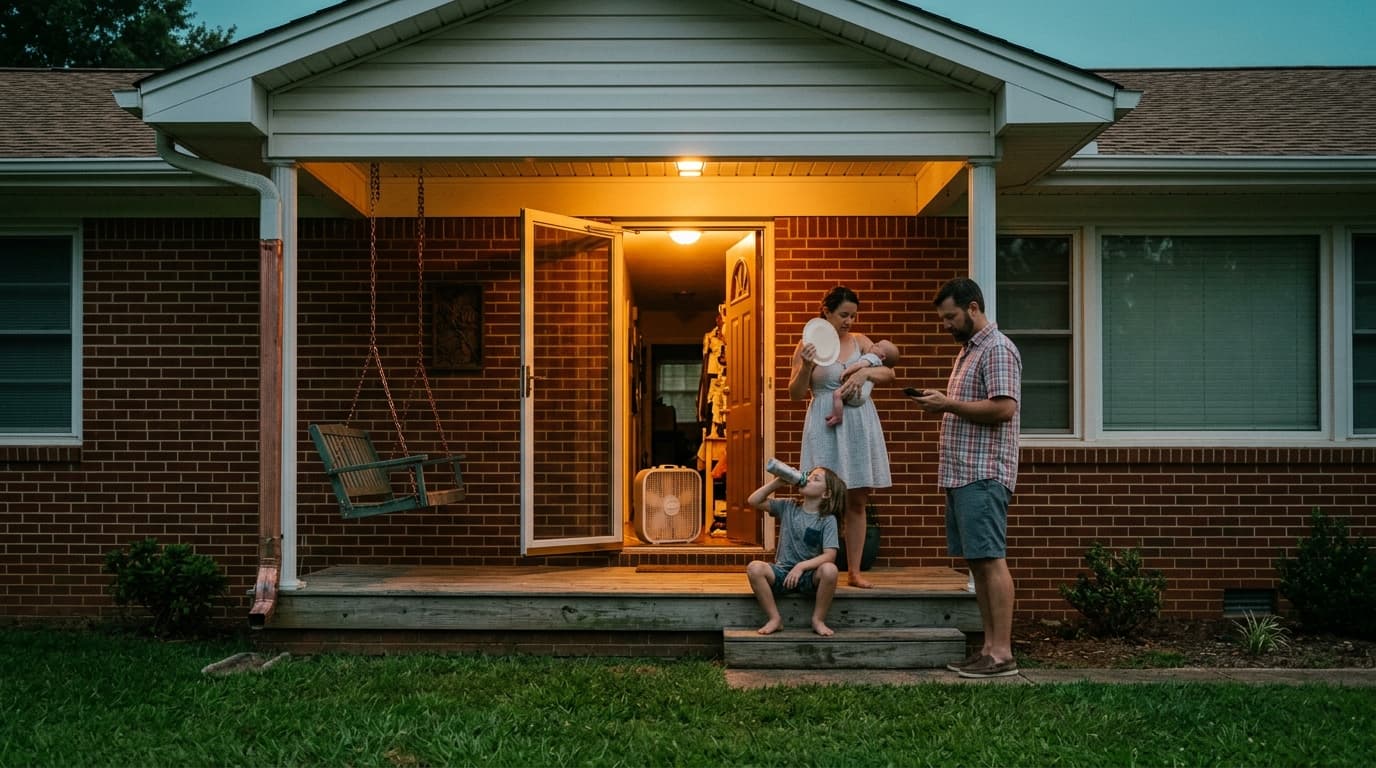
BLUF: when AC dies at 9 PM in Trussville, your triage is a 30-minute sequence. First five minutes — run three homeowner checks (thermostat, filter, breaker). Next five — call if needed and get on the schedule while you keep checking. Next twenty — execute the livable-house playbook: fans, blinds closed against the west sun residual, drink water, move kids and vulnerable family to the coolest room. Most evening Trussville calls clear by midnight either through homeowner fixes or technician truck-roll.
Why 9 PM Is Peak Trussville Call Hour
Here is the pattern I have watched for twenty-five years in Trussville. The AC fails between 7 PM and 11 PM more than any other window. Not 2 AM. Not noon. Suppertime.
Three reasons. One: the system has been running all day. Twelve to fifteen hours of continuous load. Marginal capacitors, weak contactors, tired blower bearings have been heat-soaking for hours. By dinnertime they are at their stress peak.
Two: the western sun in Trussville. Trussville homes off Highway 11 and out toward the Pinson side often have the outdoor unit on the south or west side of the house. Late afternoon sun bakes the condenser cabinet until 8 PM in July. The capacitor inside hits 140 degrees. Right after sunset is when those parts finally give up.
Three: dinner-hour electrical demand. Oven, dishwasher, dryer, fridge cycling — the house is pulling significant power. Any marginal connection in the panel, any pitted breaker, any worn contactor handles that load fine at 4 PM and fails at 8 PM. Then you notice the AC has gone quiet, walk to the thermostat, and the indoor temperature is already 84 because the failure happened during dinner and nobody was paying attention.
First Five Minutes: Homeowner Checks
Three checks. Five minutes. No tools. About 30 percent of Trussville evening calls clear at this step.
- Thermostat. Walk to the thermostat. Check: Mode = Cool. Fan = Auto. Setpoint at least 5 degrees below current room temp. If the screen is blank, pop the cover and swap the AA batteries. Wait sixty seconds — does the indoor air handler kick on?
- Air filter. Find the return air filter. Pull it. Hold it up to a light. If you cannot see light through it, replace. A clogged filter freezes the evaporator coil and shuts the system down. If you do not have a spare, run without the filter for tonight and replace tomorrow.
- Breaker. Walk to the electrical panel. Look for a 240V double-pole breaker labeled AC or Condenser. If it is in the tripped position (middle, not fully on), flip fully off then fully on. If it trips again within sixty seconds, stop and call — that is an electrical fault, see AC Tripping Breaker — Causes and Fixes.
If any of those clear it, you are done — the system should be back on within two minutes. Set the thermostat down a couple degrees, watch the supply vents cool down, and go finish the evening.
Decide: Call Now Or Wait Until Morning
Past the three checks and still no cooling. Now you decide whether to call tonight or sleep on it.
Call tonight if any of these are true:
- Indoor temperature already above 85 and climbing.
- Infant under one year in the house.
- Elderly family member (65+).
- Anyone with cardiovascular disease, respiratory issues, or on medications that affect heat tolerance (per CDC heat illness guidance).
- Outdoor temperature expected to stay above 75 overnight (no natural cooling).
- Burning smell or smoke from any part of the system.
- Outdoor unit buzzing or humming with the fan not spinning (locked-rotor compressor — kill breaker now).
You can usually wait until morning if:
- Healthy adults only.
- Indoor temperature under 82 and outdoor temperature dropping below 72 by midnight.
- You have ceiling fans, basement, or first-floor sleeping options.
- No medical risk factors in the house.
Calling at 9 PM gets a Trussville technician on site usually within 30 to 60 minutes. After-hours premium applies — that is disclosed before the truck rolls. For the full call-vs-DIY decision framework, see When to Call for Emergency AC Repair vs DIY.
Second Five Minutes: While You Are Waiting
You called. Technician ETA is 35 minutes. Use that time well.
- Find your last service receipt. Brand, model, system age — gives the technician a head start.
- Locate your air handler. Attic, basement, utility closet, or garage. The tech will go there first.
- Move pets to a back bedroom. Dogs in particular get protective when strangers come in. Keeps everyone safe.
- Turn on a porch light. Trussville driveways at 9 PM are dark. Help the tech find the house.
- Clear a path to the outdoor unit. Move bikes, garden tools, anything blocking access.
- Have a flashlight ready. Tech has one but a second pair of hands is faster.
For a full walkthrough of what the technician does once they arrive, see Moody After-Hours HVAC — What An Emergency Call Really Involves. Same procedure in Trussville, different zip code.
The Next 20 Minutes: Livable-House Playbook
Whether the truck is rolling or you decided to wait until morning, work the playbook. In order:
- Close every blind and curtain on south- and west-facing windows. The sun set but the residual heat is in the glass. Curtains slow it. Per Department of Energy guidance, closing blinds during peak sun reduces solar heat gain by 33 percent.
- Run every ceiling fan counterclockwise on high. Wind chill makes a room feel 4 degrees cooler.
- Open windows when outdoor temp drops below indoor. In Trussville this is usually 10 to 11 PM in midsummer. Open opposite sides of the house. Place a box fan in one window blowing OUT and another window blowing IN.
- Close interior doors on rooms you are not using. Concentrate cool air where the family is.
- Stop running heat-generating appliances. Dishwasher waits. Dryer waits. Even the oven exhaust is residual heat.
- Drink water continuously. Cold water for kids. Dehydration is what makes heat illness dangerous faster than the heat itself.
- Take a cool shower. Body temperature drops fast. Skin stays cool for 20 to 30 minutes afterward.
- Move to the lowest floor. A first floor or basement is meaningfully cooler than upstairs.
Per National Weather Service heat safety guidance, this playbook holds a shaded Trussville home 5 to 8 degrees below outdoor temperature overnight.
Special Care: Infants, Elderly, Vulnerable
Per CDC extreme heat guidance, the highest-risk groups in a Trussville evening AC failure are:
- Adults 65 and older.
- Infants and young children.
- Anyone with cardiovascular disease.
- Anyone on medications affecting heat regulation — diuretics, beta-blockers, antihistamines, some psychiatric medications.
For these family members specifically:
- Move to the coolest room — usually first-floor north-facing bedroom or basement.
- Place a fan within four feet for direct air movement.
- Cool, damp washcloth on neck and wrists.
- Continuous water — small sips every five minutes, not large gulps.
- Watch for headache, nausea, dizziness, confusion, or hot dry skin — those are heatstroke warning signs and need a 911 call, not an HVAC call.
- If the system will be out more than one night and a vulnerable family member is present, consider a $150 window unit from Trussville hardware. Cheap medical-grade insurance.
Sleep Strategy If Waiting Until Morning
Decision made: healthy family, no medical risks, going to ride it out until 8 AM. Here is the sleep plan that actually works in a Trussville summer.
- Sleep on the lowest floor. First-floor living room with a sofa or air mattress beats upstairs bedrooms by 5 to 10 degrees.
- Run a fan directly on each sleeper. Box fan at the foot of the bed, ceiling fan overhead, oscillating fan on the nightstand.
- Damp top sheet. Wet a thin cotton sheet in cool water, wring out, drape over the sleeper. Evaporative cooling works overnight.
- Cold pack on the pillow. A gel ice pack inside the pillowcase. Replace once during the night if you wake up.
- Hydrate before bed. 16 ounces of water. Then a glass on the nightstand for middle-of-night sips.
- Open windows after midnight. Trussville outdoor temperature usually drops below indoor by 1 AM. Open opposite sides of the house and run fans to flush hot air. Close everything at sunrise.
Most Trussville homes settle into the upper 70s overnight with this routine. Uncomfortable but sleepable.
When the Technician Arrives
Tech pulls up. Knocks. Shows ID. Puts on booties at the door if you have carpet or hardwood. From there:
- Diagnostic, 15-25 minutes. Reads voltage at the disconnect, voltage at the thermostat, capacitor microfarads, contactor condition, refrigerant pressure if relevant. By minute 25 he knows what is wrong.
- Written estimate. Sits at the kitchen table. Hands you a paper estimate with part description, labor, and total. Non-negotiable: nothing happens without written authorization.
- The fix. 20 to 45 minutes for common repairs (capacitor, contactor, fan motor, condensate clog). Longer for compressor work or refrigerant.
- System test. 15 minutes of run-time with pressures, temperatures, and amperage readings. Confirms the fix held.
- Paperwork. Receipt, warranty in writing, summary of what was found. Old part in a bag so you can see what failed.
Door-to-door, most Trussville evening calls run 60 to 90 minutes. The system is back on before midnight. The family is in cool sheets by 11.
For Trussville coverage details, see Trussville HVAC Service Area. For sister coverage in Leeds, Moody, Pinson, Clay, and Springville. For the full Trussville Tuesday-night failure pattern in detail see Moody After-Hours HVAC Call. For 2 AM emergencies see Leeds 2 AM AC Failure Checklist. For the three-scenario Springville repair playbook see Springville AC Repair Scenarios.
Trussville AC down after supper?
Run the three checks first. Then call John for evening service.
Call (205) 206-5252Byline: John, licensed Alabama HVAC technician. 25 years in the east corridor — Leeds, Moody, Pinson, Clay, Springville, Trussville. Bonded and insured.
Citations: CDC Extreme Heat Guidance · NWS Heat Safety · U.S. Department of Energy — Stay Cool Tips