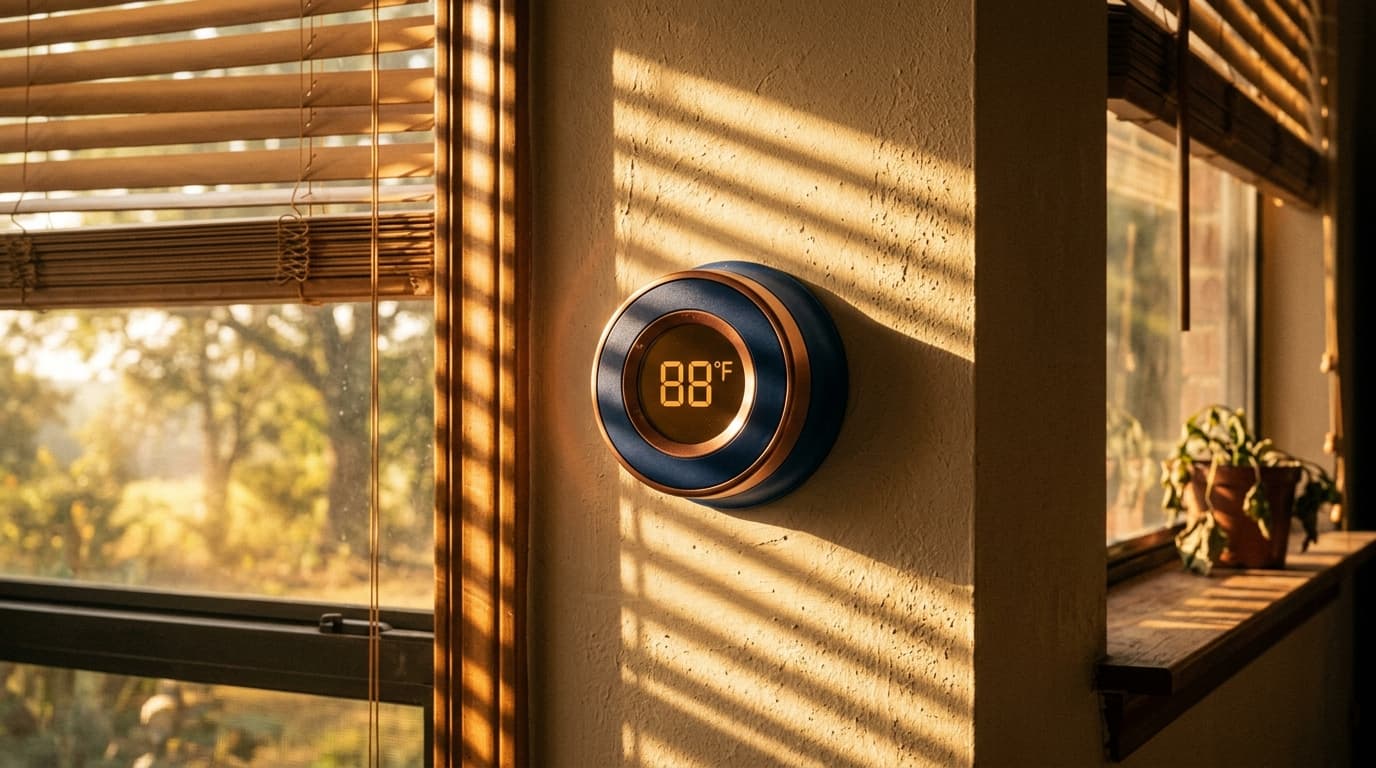
BLUF: three minutes of homeowner checks (thermostat, filter, breaker) clear roughly a third of heat-wave emergency calls. If those fail, call — but do not wait passively. Close blinds on the sun side, run ceiling fans counterclockwise, hydrate, and check on elderly family every 30 minutes. Indoor temperature over 90 with vulnerable people present is a medical situation, not a comfort situation. Window units are cheap insurance.
Why AC Always Fails in a Heat Wave
The cruel math of HVAC: the day the system is most needed is the day it is most likely to fail. Three reasons converge in a Birmingham heat wave.
First, sustained 95+ outdoor temperature pushes refrigerant pressures and amperage draws to the equipment limit. A capacitor that measured marginally low in April runs fine in cool weather — in July at peak load, it gives up. A contactor with pitted contacts that arc once a day in spring arcs every cycle in August. Marginal parts that survive cool weather fail in heat.
Second, condenser coils are dirtier in late summer. Cottonwood from May, grass clippings from June, pollen from spring — all of it accumulates in the outdoor coil fins. A clean coil rejects heat efficiently. A coil packed with debris pushes head pressure higher, amperage higher, and the compressor closer to its overload threshold.
Third, runtime doubles. A central AC that runs 8 hours a day in mild weather runs 16 to 18 hours a day during a heat wave. Twice the wear, twice the heat soak on internal components, and half the cool-down time between cycles. It is the same reason cars break down on long highway drives more than short trips.
The Three-Minute Homeowner Check
Before you call, run these three checks:
- Thermostat. Mode = Cool. Fan = Auto. Setpoint = five degrees below current room temp. Wait 60 seconds. If the indoor air handler kicks on, your thermostat was the problem (battery, setting, or someone bumped it).
- Air filter. Pull it. Hold to a light. If you cannot see light through it, replace. A clogged filter starves airflow, freezes the evaporator coil, and shuts the system down. Per the U.S. Department of Energy, filter replacement is the single most-skipped maintenance task and the most common preventable failure.
- Breaker. Walk to the panel. Look for a 240V double-pole breaker labeled AC, Condenser, or Air Handler in the tripped position (middle, not fully on). Flip fully off, then fully on. If the system runs, you are good. If the breaker trips again, stop — that is an electrical fault. See our tripping breaker guide.
The Livable-House Playbook
While the technician is en route, do these in order. They take ten minutes total and meaningfully lower indoor temperature.
- Close every blind and curtain on south- and west-facing windows. Direct sun through glass adds heat fast. Per the U.S. Department of Energy, closing blinds during peak sun can reduce solar heat gain by 33 percent.
- Run every ceiling fan counterclockwise on its highest setting. Fans do not lower temperature but the wind chill effect makes a room feel 4 degrees cooler.
- Close interior doors on rooms you are not using. Concentrate cool air where you live.
- Stop running heat-generating appliances. Oven, stovetop, dryer, dishwasher. Eat sandwiches today. Dryer goes outside or waits.
- Drink water continuously. Dehydration is what makes heat illness dangerous, faster than the heat itself.
- Move to the lowest floor. Heat rises. A first floor or basement is meaningfully cooler than upstairs.
- Open windows after sunset if outdoor temperature drops below indoor. Run a window fan to flush hot air. Close again before sunrise.
Per the National Weather Service heat safety guidance, these tactics together keep an unconditioned Birmingham home 5 to 10 degrees below outdoor temperature.
Protecting Vulnerable Family Members
Heat illness does not affect everyone equally. Per the CDC extreme heat guidance, the highest-risk groups are: adults 65 and older, infants and young children, anyone with cardiovascular disease, anyone on certain medications (diuretics, beta-blockers, antihistamines, some psychiatric medications), and outdoor workers.
Check on elderly family members and neighbors every 30 minutes during a heat-wave AC failure. Watch for headache, dizziness, nausea, confusion, or skin that is hot but not sweating — these are heatstroke warning signs and they need a 911 call, not an HVAC call.
For infants: a window unit in the nursery is non-negotiable until the central AC is repaired. Babies cannot regulate body temperature efficiently. A bedroom held at 78 degrees with a window unit is safer than the rest of the house at 88.
Window Units as Cheap Insurance
A 5,000 to 8,000 BTU window unit cools a 150 to 350 square foot bedroom. Most Birmingham hardware stores stock window units year-round at $150 to $300. During a heat-wave AC failure, that is the cheapest medical-grade insurance you can buy.
The math: an emergency after-hours service call premium is meaningful money. A window unit is meaningful money. The window unit lasts ten years and lives in the closet for the next failure. If your central AC is older than 12 years, keeping a window unit on hand is just smart — failures happen on the worst day.
When to Leave for a Cooling Center
If indoor temperature exceeds 90 degrees, vulnerable family members are present, and the technician is more than two hours out — leave the house. This is not weakness, it is medical safety. Birmingham public libraries, Hoover Senior Center, JCC senior facilities, and shopping malls operate as informal cooling centers during heat advisories. Most stay open until 9 PM.
During declared heat emergencies, Birmingham, Jefferson County, and Shelby County emergency management open formal cooling centers. Check Birmingham.al.gov, jeffcoal.org, and the city of Hoover, Mountain Brook, and Helena for current locations.
What a Technician Usually Finds
On heat-wave emergency calls in the east corridor — Birmingham, Trussville, Mountain Brook, Chelsea, Calera, Montevallo, Helena, and Leeds — the failures cluster:
- Failed dual-run capacitor — most common, 20-minute fix.
- Tripped breaker that needs underlying cause diagnosed.
- Frozen evaporator coil — usually filter or refrigerant.
- Condensate float switch tripped — clogged drain line.
- Failed contactor — sometimes ant nest inside.
- Compressor on the way out — repair-vs-replace conversation.
We give a written estimate before any work begins. No surprise invoices, no upsell. Heat-wave calls are stressful enough without an unexpected bill on top.
For more detail on common emergency repair scenarios, see the emergency repair page, the emergency AC repair near me Birmingham guide, and the when to call HVAC emergency vs DIY dispatch.