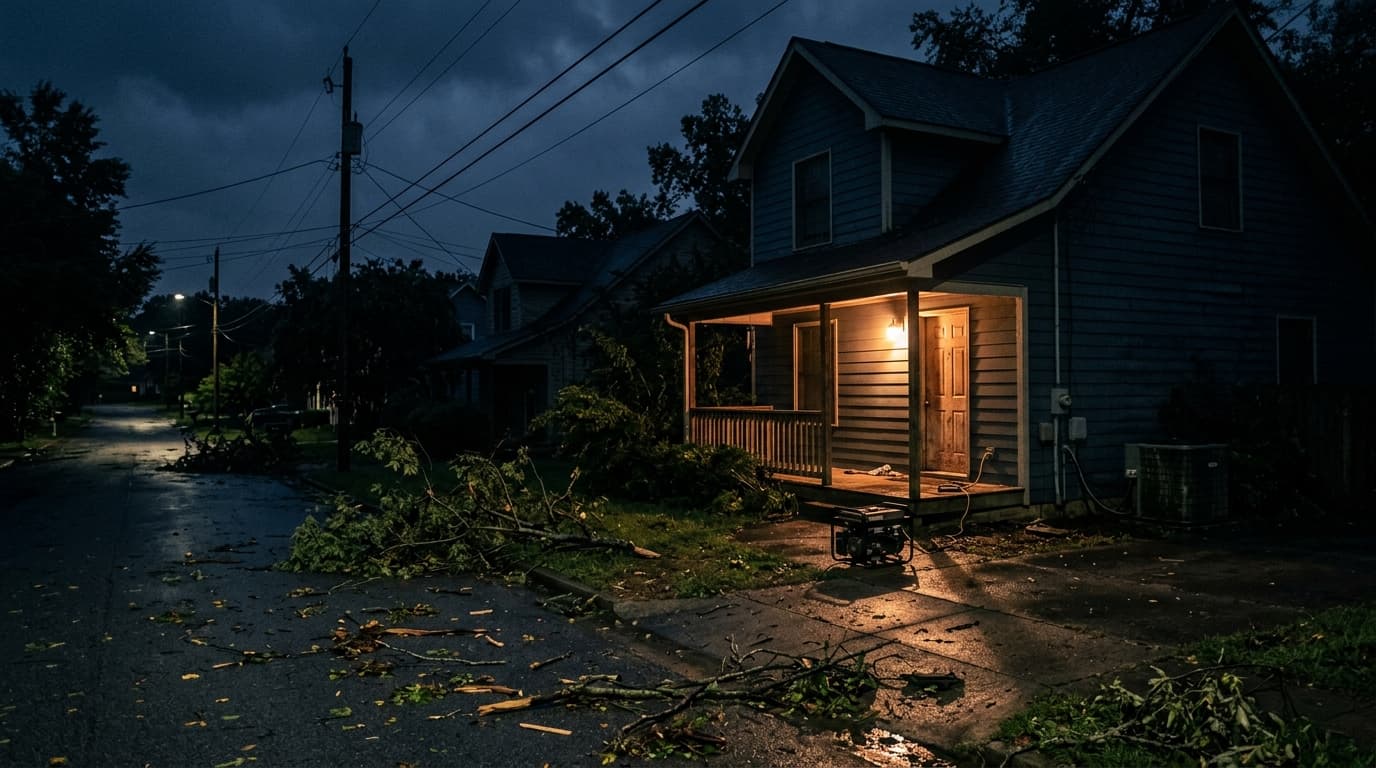
BLUF: power outages take three things from an AC system — surge damage, breaker trips, and lockout protection. Wait five minutes after power returns. Then run the reset sequence below: thermostat off, breaker off, wait, breaker on, wait, thermostat on. If that does not start the system, common failures are blown 24V transformer, surge-damaged control board, or pitted contactor. A whole-home surge protector at the panel prevents most of this.
What Actually Happens to an AC During an Outage
Power outages are not just absence of power. The bigger problem is what happens at the edges. As power fails, voltage sags before it drops — the AC briefly tries to run on undervoltage, drawing extra current. As power returns, voltage swings can spike before stabilizing, and any nearby utility switching operations can throw transient voltage onto the line. Per NIST power quality research, residential service entrances regularly see transient surges in the kilovolt range during severe weather events.
Modern AC systems are more vulnerable to this than the systems your grandparents had. Old AC was a compressor, a fan, a transformer, and a contactor — robust electromechanical parts. Modern AC adds: control boards, communicating thermostats, ECM motor modules, and digital displays. All of those are sensitive to surges that the old hardware shrugged off.
The result: after a Birmingham summer storm with a power blip, you can have a system that looks fine but has a quietly damaged 24V transformer, control board, or capacitor. Sometimes it works for a week and then fails. Sometimes it does not start at all when power returns.
Why You Wait Five Minutes
Most modern thermostats and control boards have a built-in 5-minute anti-short-cycle delay. When the compressor runs, refrigerant pressures inside it climb to a head pressure of 250 to 400 PSI. When the compressor stops, those pressures need 3 to 5 minutes to equalize through the system. If the compressor restarts before equalization, it tries to start against high head pressure — drawing locked-rotor amperage and stressing windings.
Power outages bypass that delay. The thermostat loses its anti-short-cycle timer when it loses power. When power returns, if the thermostat immediately calls for cooling and the compressor is still pressurized, the restart is hard on the equipment.
The fix: wait five minutes after power returns before doing anything. If the thermostat is on, the system is safely under its own anti-short-cycle delay. If it is off, you are letting the equipment cool and equalize before the next restart. Five minutes is cheap insurance.
The Structured Reset Sequence
Run these steps in order after a Birmingham outage:
- Thermostat to Off. Pull it down from any temperature it shows.
- Breaker off. Find the 240V double-pole breaker labeled AC or Condenser. Flip fully off.
- Wait five minutes. Let pressures equalize and let any residual voltage on capacitors discharge.
- Breaker on. Flip back to fully on. Listen for any humming, ticking, or arcing sounds. If you hear any, flip it back off and call.
- Wait one more minute. Lets the control board boot.
- Thermostat to Cool, Fan Auto. Setpoint five degrees below current room temp. Wait 60 seconds for the indoor air handler to start, then walk to the outdoor unit and verify the condenser fan is spinning.
If the indoor air handler does not start, the most likely cause is a blown 24V transformer in the air handler — a $50 part replaceable in 30 minutes. If the air handler runs but the outdoor condenser does not, the most likely cause is a surge-damaged contactor or capacitor at the outdoor unit.
The Five Common Post-Outage Failures
- Blown 24V control transformer. The most common surge casualty. Symptom: thermostat blank or showing no power, indoor unit silent, no system response. The transformer is a small box near the air handler control board; replacement is straightforward.
- Tripped breaker that did not visibly trip. Some breakers fail to fully reset after voltage events — the handle stays in the on position but the contacts internally are open. Cycle the breaker manually (off, then on) regardless of where the handle appears to be.
- Surge-damaged control board. Symptom: thermostat displays normally, calls for cooling, but no fan, no contactor click, nothing. The control board took a hit. Replacement is a $200 to $500 part.
- Pitted or welded contactor. Surge arcing across the contactor contacts can pit them or weld them in either position. Welded closed = AC runs constantly even with thermostat off. Welded open = AC will not start. Either way, contactor swap.
- Damaged capacitor. A surge can knock a marginal capacitor over the line. Symptoms match the standard failed-capacitor signs — humming with no spin, or no startup at all. See our tripping breaker guide for the full diagnostic.
Whole-Home Surge Protection
The single best long-term fix for post-outage HVAC failures is a whole-home surge protector mounted at the main electrical panel. Per IEEE surge protection standards, a Type 1 or Type 2 SPD installed at service entrance protects every circuit in the house including AC, refrigerator, electronics, and well pumps from the most common transient surges.
Cost: $200 to $400 for the device, plus $200 to $400 for installation by a licensed electrician. For Birmingham homes — central Alabama gets among the highest lightning strike densities in the United States — this is among the highest-leverage maintenance investments you can make. A single surge-induced AC failure costs more than the surge protector that would have prevented it.
Brands worth knowing: Eaton CHSPT2ULTRA, Siemens FS140, Square D HEPD80. Any of these installed correctly to a properly grounded panel does the job.
If the AC Came Back But Sounds Different
New noise after a power event is a yellow flag — sometimes red. It usually means a component took partial damage and is operating outside spec. The system may run for hours or days before final failure, often at the worst possible moment.
Symptoms to take seriously: louder humming from the outdoor unit than yesterday, longer runtime than yesterday, weaker airflow than yesterday, warm air from the registers, water pooling near the air handler, smell of overheating electrical insulation. If any of these show up after a power event, cut power at the outdoor disconnect and call. Decode the specific noise with our AC humming noise guide.
Should I Run AC on a Generator?
Honest answer: usually not. Residential central AC pulls 15 to 40 amps at 240V — meaning it needs 3,600 to 9,600 watts of starting capacity from the generator. Most portable generators are 3,000 to 5,000 watts and cannot start a residential AC compressor. The compressor either does not start, or it browns out the generator and trips the generator breaker.
What works: a 7,500+ watt portable or standby generator with proper transfer switch wiring. Or a window unit at 5,000 to 8,000 BTU drawing 500 to 800 watts that any portable generator can handle. For Birmingham homeowners who lose power frequently in summer storms, a small window unit and a 3,000-watt portable generator covers a bedroom — which is what matters during a multi-hour outage.
Per NFPA 70 (NEC), generator backfeed into utility wiring is illegal and dangerous. Always use a manual or automatic transfer switch installed by a licensed electrician — never run extension cords from a generator into an outlet.
For our coverage in Birmingham and the east corridor — Trussville, Mountain Brook, Chelsea, Calera, Montevallo, Helena — and what an emergency call after a storm actually looks like, see the emergency repair page.