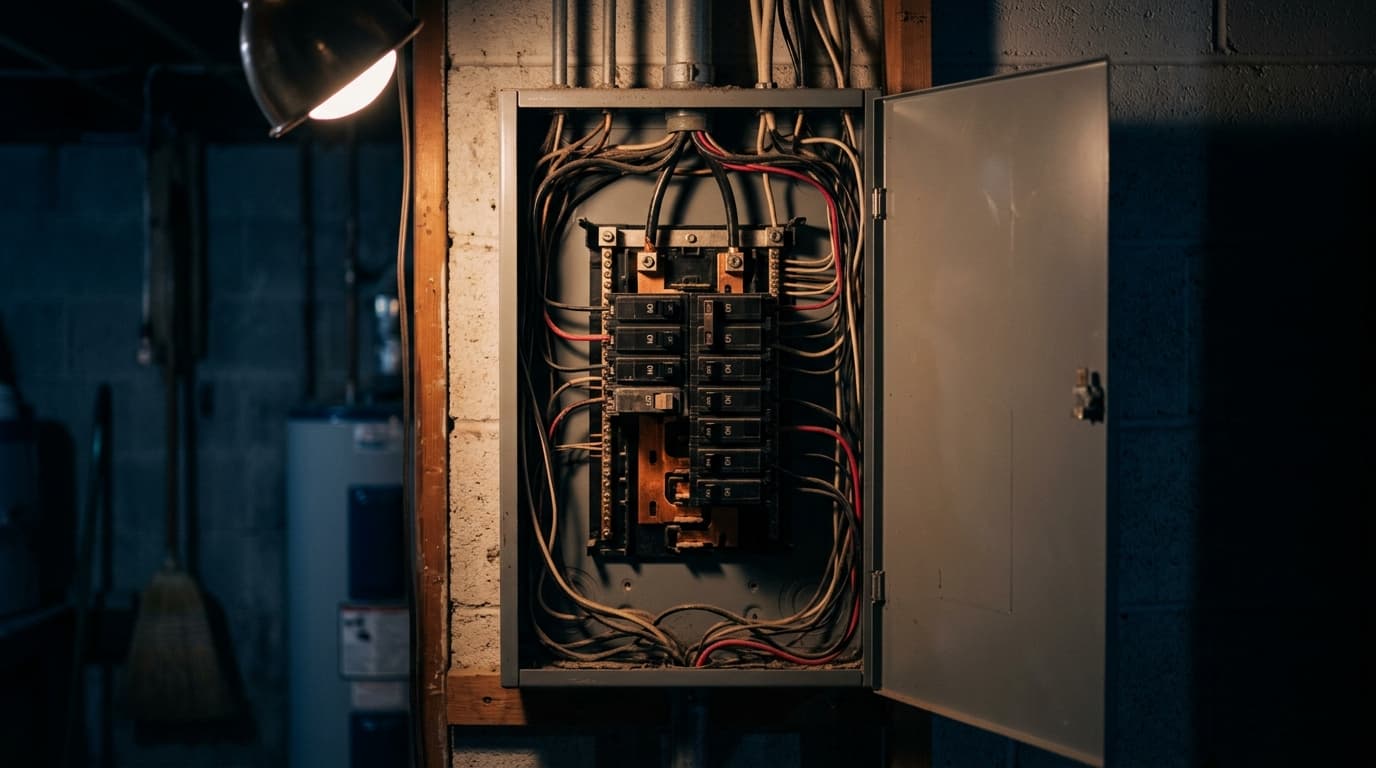
BLUF: a tripping breaker is a real fault, not a glitch. Most common cause in Alabama summer is a failed dual-run capacitor — under $30 part, 20-minute fix. Second most common is a dirty condenser coil restricting heat rejection. Third is a shorted compressor or contactor. Reset the breaker once. If it trips again, stop and call. Resetting repeatedly can damage the compressor, melt wiring, or start a fire.
What a Breaker Actually Does
A breaker is a current-sensing safety device. When the load on the circuit exceeds the breaker rating — say a 30-amp breaker sees 35 amps — it opens the circuit to prevent the wiring from overheating and starting a fire. Per the National Electrical Code (NFPA 70), residential central AC requires a dedicated 240V double-pole breaker sized to the equipment nameplate, typically 30 to 60 amps depending on tonnage.
When that breaker trips, it is doing its job. The fault is upstream of the breaker — in the wiring, the disconnect, the contactor, the capacitor, the compressor, or the condenser fan motor. Resetting the breaker is fine once. Twice is risky. Three times is dangerous.
Cause #1: Failed Dual-Run Capacitor
The dual-run capacitor is a small cylindrical part — usually labeled with a microfarad rating like 45/5 or 35/5. It stores electrical charge and dumps it during compressor and fan motor startup, giving them the boost they need to overcome locked-rotor inertia. Without enough capacitance, the compressor still tries to start, but it draws excessive amperage trying. That amperage can trip the breaker.
Symptoms: outdoor unit hums but does not spin. Or it tries to start, you hear a click, and the breaker trips immediately. Or the fan spins but the compressor does not. A technician verifies with a multimeter — measure capacitance against the label rating. A 45/5 capacitor that reads 38/4 is failed.
Why it fails so often in Alabama: capacitors are temperature-sensitive. Sustained 95+ degree summer heat shortens their life by half. Most dual-run capacitors are rated for 5 to 10 years of service life — in Birmingham summer they often die at 4 to 6. Replacement is a 20-minute job once you have the part. This is the most common single failure on emergency AC calls in our territory.
Cause #2: Dirty Condenser Coil
The outdoor condenser rejects heat from the refrigerant to outdoor air. When its fins are packed with cottonwood, leaves, grass clippings, dog fur, or kudzu (this happens in Birmingham), it cannot dump heat fast enough. Refrigerant pressure climbs. The compressor draws more amperage trying to compress against higher head pressure. Past a threshold, breaker trips.
The fix: cut power at the disconnect. Spray the condenser coil with a garden hose from the inside out — water flows opposite the airflow direction, which carries debris away from the fins instead of packing it deeper. Per Energy Star maintenance guidance, this is part of routine annual cleaning and resolves a meaningful number of late-summer tripped-breaker calls.
Cause #3: Failed Contactor
The contactor is the relay inside the outdoor unit that switches 240V power to the compressor and condenser fan when the thermostat calls for cooling. When its contacts pit, weld together, or arc, it can either fail open (no power, no trip) or fail with intermittent shorts (power, trip).
Specific Alabama failure mode: ants. They nest in contactors. The acid from their bodies corrodes contacts. We pull contactors full of ant carcasses regularly. The fix is a $30 contactor swap and a check of the rest of the unit for nests.
Cause #4: Shorted Compressor Winding
When a compressor winding shorts to ground or to another winding, it draws massive amperage instantly — often 60 to 80 amps on a 30-amp circuit. The breaker trips immediately, every time. Resetting it makes the situation worse: you are dumping that amperage into already-damaged windings.
A technician verifies with a megohmmeter (megger) — measures insulation resistance from each winding to ground. A healthy compressor reads above 1 megohm. A shorted compressor reads near zero. Once confirmed, the conversation shifts: a compressor replacement on a 5-year-old high-end system makes sense. On a 14-year-old builder-grade system, it does not — and we are talking full system replacement.
Cause #5: Ground Fault in Wiring
Less common but serious. Refrigerant copper line-set chafing against a roof rafter or a wire pinched in a flexible whip can short to ground. Same effect as a shorted compressor — instant trip. Visual inspection of the line-set, the disconnect, and the whip usually finds it. This is a wiring repair, not an equipment repair.
Cause #6: Weak or Undersized Breaker
Breakers weaken over 20+ years of cycling. Federal Pacific Stab-Lok and Zinsco panels are documented for premature breaker failure. A breaker that trips at 22 amps when rated for 30 is the problem — not the equipment. Verification: clamp meter on the wire while the AC runs. If the compressor draws 18 amps and the breaker trips at 22, replace the breaker. If the compressor draws 35 amps on a 30-amp circuit, the equipment is the problem.
On older panels, we sometimes recommend a panel evaluation by a licensed electrician. Federal Pacific Stab-Lok panels in particular have documented thermal-trip failure rates and replacement is a separate scope.
The Diagnostic Order a Technician Follows
When the truck arrives on a tripped-breaker call, here is the structured order:
- Visual inspection. Burning smell at the panel, condenser, or disconnect? Stop and call electrician. Otherwise continue.
- Disconnect the outdoor unit. Reset the breaker. Does it hold with the AC isolated? If yes, the fault is in the outdoor unit. If no, the fault is in the wiring or breaker itself.
- Capacitor test with multimeter. Most common fix.
- Contactor inspection. Pitted, welded, or full of ants?
- Compressor megger test. Insulation resistance to ground.
- Amperage measurement at startup. Does the compressor exceed nameplate locked-rotor amps?
- Refrigerant pressure check. Overcharge causes high amp draw. Per EPA Section 608, only certified technicians can recover or charge refrigerant.
- Breaker test. Last on the list. Most rarely the actual problem.
When to Stop Resetting and Call
Reset the breaker once. If it trips again within 30 seconds, stop. If it holds for a few minutes then trips, stop. If you smell burning plastic, see smoke, or feel heat on the breaker face, cut the main breaker for the entire panel and call from outside the house. Those are real fire risks.
The cost of one diagnostic call is small. The cost of an electrical fire is enormous. Modern breakers do not trip without cause. Trust them.
For our coverage area across the east corridor — Birmingham, Trussville, Mountain Brook, Chelsea, Calera, Montevallo, and Helena — see the emergency repair service page for what an emergency call actually looks like.