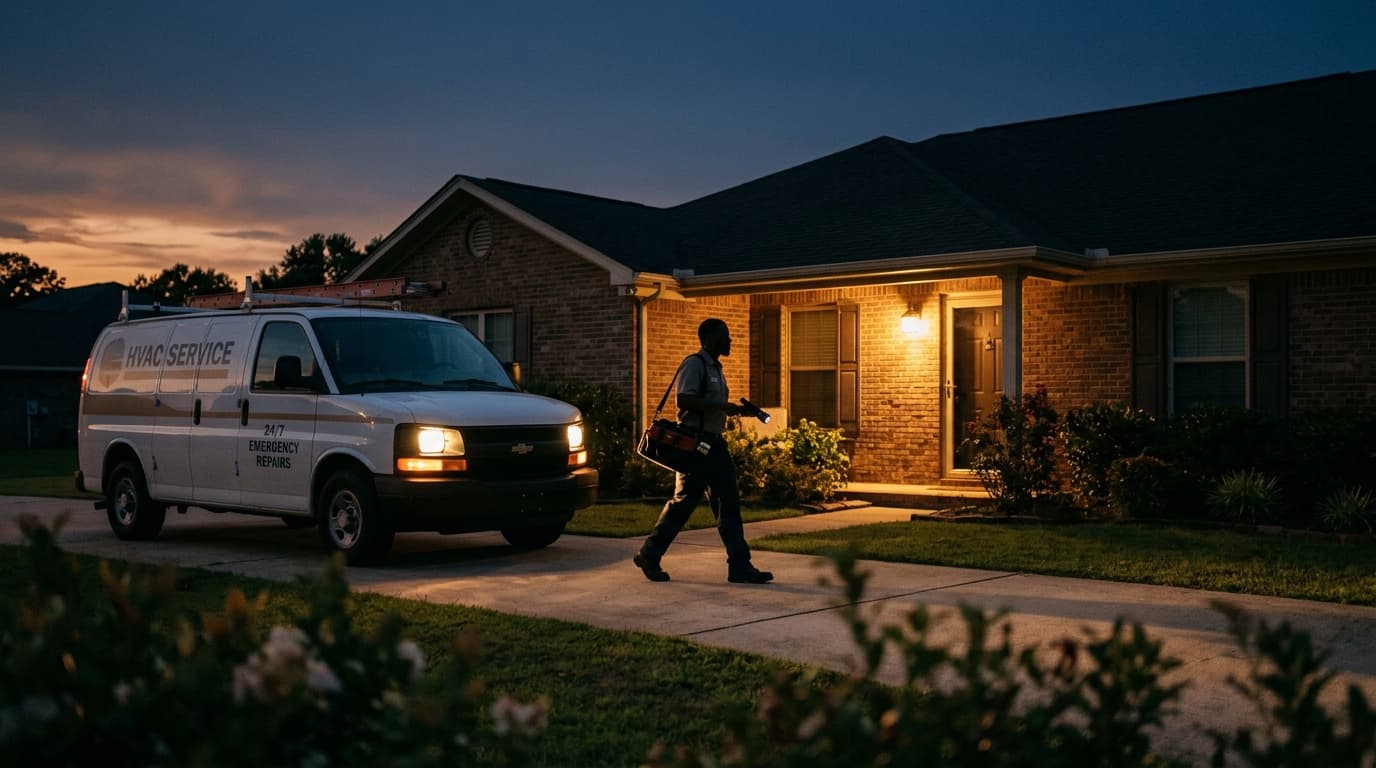
BLUF: a typical Moody after-hours call runs about 75 minutes door-to-door. The first ten minutes are phone triage and rolling the truck. Twenty-five minutes on site for diagnosis, written estimate, and homeowner approval. Forty minutes for the actual fix, system test, and paperwork. Most failures — capacitors, contactors, common fan motors, condensate clogs, float switches — get fixed that night with parts off the truck. The honest part of after-hours work is the pricing transparency: written estimate before any tool comes out of the bag, no surprise invoice.
The Phone Call — Phone Triage in Two Minutes
The phone rings. I am at the kitchen table finishing dinner. The Moody area code shows on the screen — could be Moody proper, could be the Odenville side, could be off Highway 411 toward St Clair.
I run through phone triage in two minutes. Same questions every call:
- What is the system doing right now? (Off completely, running but not cooling, tripping breaker, making noise.)
- How old is the system? (Tells me parts availability, refrigerant type, and rough condition.)
- What is the indoor temperature? (Severity check.)
- Who is in the house? (Vulnerable family changes the urgency.)
- Have you done the basics? (Thermostat, filter, breaker — about a third of calls clear on the phone.)
If the basics clear it, I do not drive out and the customer does not pay. If they do not clear it, I quote the after-hours trip diagnostic flat-rate and ask if they want me to roll. No mystery on price. If they say yes, I read back the address, get a callback number, and tell them my ETA. Eighteen minutes.
The Truck Roll — What Is In The Van
Look. An after-hours technician without truck stock is just a guy in a van. Supply houses close at 5 PM. If I do not have the part, I am not fixing it tonight.
The truck rolls with — minimum — the following standard repair parts:
- Dual-run capacitors in common sizes (35/5, 40/5, 45/5, 50/5, 60/5, 70/5, 80/5 microfarad).
- Contactors in 24V and 240V coil, single-pole and double-pole, 30A and 40A.
- Universal condenser fan motors (1/4 HP, 1/3 HP, 1/2 HP) with capacitor kits.
- Universal blower motor and an X13 replacement motor.
- Control board kits for Goodman, Trane, Carrier, Lennox, Rheem, York — the big six in Moody.
- Condensate pump, float switches, drain pan tablets, PVC fittings, drain line cleaning kit.
- Hard-start kit and a 5-2-1 compressor saver.
- R-410A and R-22 refrigerant, gauge set, leak detector.
- Thermostats — basic and smart — for emergency replacement.
That parts inventory covers about 80 percent of east-corridor failures. The other 20 percent is rare boards, OEM-specific inverter parts, and major component replacement (compressor, evaporator coil) — those become a return trip with a supply-house pickup the next morning.
Arrival — The First Five Minutes at the Curb
I pull up to the house. Lights on inside. I park on the street, not the driveway — gives the homeowner space, and if a flatbed needs to come the next day for a major job, my van is not blocking the way.
Before I knock, I walk the outside of the house. Looking at the outdoor condenser unit through the gate or fence if visible. Listening for the fan. Looking at the disconnect box for damage. Looking at the meter base for any oddity. Thirty seconds of curb diagnosis often tells me what is wrong before I ring the bell.
At the door I introduce myself, show ID, and ask permission to come inside. I wear booties over my boots in any house with carpet or hardwood. I write down the homeowner name, the address, and the time on a job sheet that ends up in their hand at the finish.
Diagnosis — What the Meter Actually Reads
Diagnosis is not guessing. It is a sequence with a meter.
- Thermostat reading. Confirm set point, mode, fan, current room temp.
- Indoor air handler check. Power at the board, voltage at the transformer (24V), filter condition, blower running.
- Condensate drain. Float switch state, drain pan dryness, drain line clear.
- Outdoor disconnect. Voltage incoming (240V), disconnect closed, low-voltage signal from thermostat present (24V).
- Capacitor test. Discharge first, then microfarad reading on the meter. Compare to the spec on the side of the can. If it reads more than 10 percent low, it is failed.
- Contactor check. Visual for pitting and ant damage, voltage across, continuity when energized.
- Condenser fan motor. Spin freely by hand, no bearing play, capacitor reading good, amp draw under load.
- Compressor. Locked-rotor test if not running, amp draw on each leg if running, head pressure and suction pressure reading.
On a Moody call, this whole sequence takes 15 to 25 minutes. By minute 25 I know what is wrong, what it costs, and how long the fix will take. Now I write it down.
The Written Estimate — Before Any Work
Every repair gets a written estimate before any tool comes out of the bag. Part description, part number if relevant, labor, total. I sit at the kitchen table and hand it to the homeowner. They read it. They sign or they say no.
This is non-negotiable. No surprise invoice at the end. No upsell pressure. No verbal promises that change on the bill. If the homeowner declines the repair, they pay the trip diagnostic and I leave the system as I found it.
If during the fix I find a second issue — a contactor that is also marginal, for example — I stop work, write an amended estimate, and get a second signature. Same standard. No work without signed authorization.
The Fix — Capacitor, Contactor, or Worse
About 40 percent of after-hours calls in Moody are dual-run capacitors. About 15 percent are contactors. About 10 percent are condenser fan motors. About 8 percent are condensate clogs and float switches. The rest is a long tail of less common failures.
For a capacitor swap — the most common Moody after-hours fix — the process:
- Kill power at the disconnect and at the breaker. Two-point lockout.
- Pull the access panel on the side of the condenser.
- Discharge the old capacitor with an insulated screwdriver across the terminals — a fully charged capacitor will knock you down hard.
- Note the wire colors and terminal labels (HERM, FAN, C). Photograph it for the file.
- Pull the old part, install the new part, transfer the wires exactly.
- Tighten the strap, replace the panel, restore power at the breaker, then the disconnect.
- Set the thermostat to call for cooling and watch the start.
Twenty minutes if nothing fights you. Thirty if the strap is rusted or the wires are crispy. For the why and the diagnosis side of capacitor failure, see AC Tripping Breaker — Causes and Fixes and AC Making a Loud Humming Noise.
The System Test — Pressures, Temperatures, Amps
After the fix, the system runs for fifteen to twenty minutes under test conditions. I take readings:
- Supply air temperature at a vent — should be 18 to 22 degrees colder than return air temperature in proper operation.
- Suction pressure on the refrigerant gauge — should match the spec for the outdoor temperature and refrigerant type.
- Head pressure — same.
- Amperage draw on the compressor and the condenser fan motor — should be at or below nameplate FLA (full-load amps).
- Capacitor reading under load — confirms the new part is performing.
If any number is off, the work is not done. Per Department of Energy maintenance guidance, proper diagnostic readings are the difference between a real repair and a guess.
Leaving — What the Homeowner Gets in Hand
Before I leave, the homeowner gets:
- The signed estimate, marked completed, on paper or as a PDF to their email.
- The old part — the dead capacitor, the burned contactor — in a bag. They can see what was wrong.
- The part warranty in writing.
- A one-page summary of what I found and what to watch for next.
- A receipt of payment.
And a number for follow-up if anything acts up in the next 30 days. That last one matters. A real after-hours technician stands behind the work — call back if it does it again and we make it right.
Pricing — Why After-Hours Costs More
Let me be straight with you. After-hours pricing exists because:
- The technician is sitting at home at 9 PM available to roll out. That availability has a cost.
- Supply houses are closed. We pull from truck stock priced higher than wholesale because we cannot reorder until morning.
- Driving Moody, Odenville, Springville, and the St Clair side of Highway 411 at 9 PM takes longer per call than daytime — one call instead of two.
- Insurance and licensing carry whether the work is at 10 AM or 10 PM.
The premium is honest cost recovery. It is disclosed before the truck rolls. No surprise.
For more on the call-vs-DIY decision, see When to Call for Emergency AC Repair vs DIY. For what to check before you call, see the Leeds 2 AM AC Failure Checklist — the seven checks apply equally in Moody. For the symptoms that mean stop and call now, see AC Not Working After Power Outage.
Moody coverage: from the I-20 exits through downtown Moody and out to the Odenville line. Same evening response window as Leeds, Pinson, and Trussville — usually under 30 minutes from call to wheels rolling.
Moody after-hours emergency?
Call John. Phone triage first — about a third of calls clear before the truck rolls.
Call (205) 206-5252Byline: John, licensed Alabama HVAC technician. 25 years in the east corridor — Leeds, Moody, Pinson, Clay, Springville, Trussville. Bonded and insured.
Citations: U.S. Department of Energy — Maintaining Your Air Conditioner · ENERGY STAR Heating and Cooling · EPA Indoor Air Quality