BLUF: about a third of 2 AM AC calls in Leeds clear in five minutes — thermostat batteries, a bumped setting, a clogged filter starving airflow, a tripped breaker from an afternoon storm, or a condensate float switch that finally tipped. Run the seven checks below in order before you call. If you get past all seven and the system is still dead, you have a real failure and we need to come out. Two checks tell you to cut power right now and not call anyone except 911 — those are at the bottom.
Why AC Always Dies at 2 AM in Leeds
Here is the thing nobody tells you. Your AC does not actually fail more often at 2 AM. It fails more often when it is running hard — and in a Leeds summer, that is overnight when humidity sits at 90 percent and the system never gets a real break. The compressor cycles, the capacitor weakens, the bearing in the outdoor fan whines a little louder. Then sometime between midnight and four, the marginal part finally gives up.
Leeds homes built between 1985 and 2005 — most of the ones off Highway 78 and out toward I-20 — also share a quirk. The outdoor condenser usually sits on the south or west side of the house, baking all afternoon. By 2 AM the cabinet metal is still warm, the capacitor inside is still warm, and the rubber-mounted compressor has been heat-soaking for hours. Marginal parts that survive cool weather fail in heat. Now you know why.
The good news: about a third of these middle-of-the-night calls are not real failures at all. They are easy stuff — a thermostat someone bumped reaching for the light switch, a clogged filter, a condensate float switch that finally tipped after a humid week. The next five minutes will tell you which kind of night you are having.
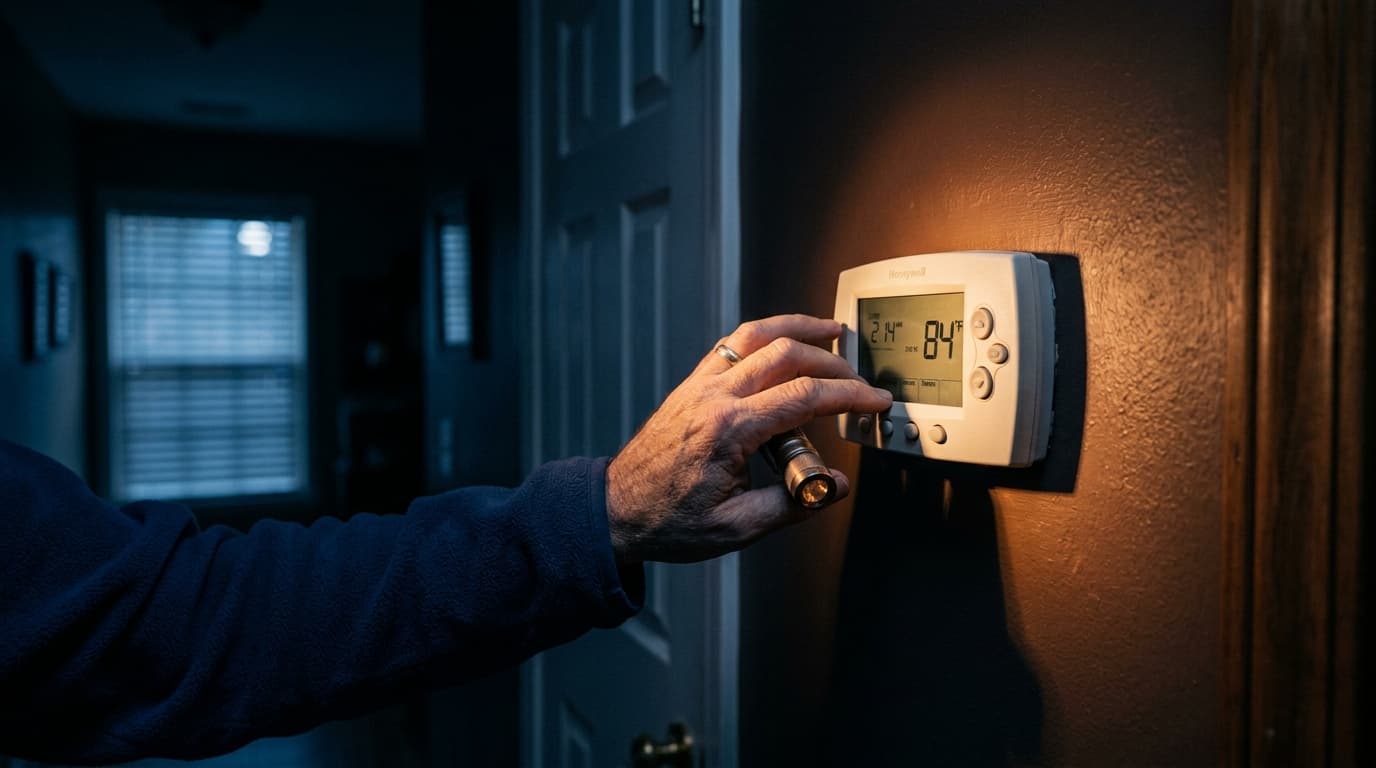
Check 1: Thermostat
Walk up to the thermostat. Look at the screen.
- Blank screen. Pop the cover. Swap the two AA batteries. If the screen lights up and the system kicks on within sixty seconds, you are done. Go back to bed.
- Screen lit but system not running. Confirm Mode = Cool. Fan = Auto. Setpoint five degrees below current room temp. Wait sixty seconds. If the air handler kicks on, somebody bumped it during the day.
- Screen reading "Low Battery" or "Replace Battery". Swap them. Many smart thermostats lose communication with the system before the screen goes fully dark.
- Smart thermostat showing a Wi-Fi error or a sync error. Hold the power-off button for ten seconds. Let it reboot. Common with Nest, Ecobee, and Honeywell Lyric units after a Spectrum or AT&T outage.
Per the U.S. Department of Energy, thermostat replacement and basic settings are the most common DIY-fixable issue in residential HVAC. About one in five middle-of-the-night calls in Leeds clears at this step.
Check 2: Air Filter
Find your return air filter. In most Leeds homes it sits in a slot near the air handler — usually in the hallway ceiling, the laundry room wall, or down at the furnace itself if your air handler is in the basement.
Pull it. Hold it up to a light or your phone flashlight. If you cannot see light through it, replace it. A clogged filter starves the evaporator coil of airflow. The coil drops below 32 degrees and ices over. The system loses cooling capacity, then trips a safety, then sits silent.
If you do not have a spare filter, pull the dirty one out and run the system without it for the rest of the night. Yes, you will get dust in the coil — but a couple of hours of unfiltered run beats a frozen coil and a stripped evaporator. Replace the filter first thing in the morning. Per Department of Energy guidance, filter replacement every 30 to 90 days is the single most-skipped maintenance task in American homes.
Check 3: Breaker Panel
Walk to your electrical panel. Open the door. Look for two breakers:
- A 240-volt double-pole breaker (two switches tied together) labeled AC, Condenser, or Outdoor Unit.
- A separate single-pole breaker labeled Air Handler, Furnace, or Indoor Unit.
Either one in the tripped position — handle sitting in the middle, not fully on, not fully off — means the system lost power. Flip it fully off, then fully on. Wait sixty seconds. If the system kicks back on and runs normally, you had a nuisance trip from an afternoon storm or a brief utility surge. Leeds gets hit hard with summer pop-up thunderstorms — this is the second-most-common easy fix.
If the breaker trips again within sixty seconds, stop. Do not reset it a third time. You have a real electrical fault — see our AC tripping breaker field guide. Forcing a breaker that wants to trip can damage compressor windings and start a wire fire inside the cabinet.
Check 4: Disconnect Switch Outside
This one homeowners forget exists. Right next to your outdoor condenser unit — usually mounted on the exterior wall of the house — there is a small gray box about six inches square. That is the disconnect. It contains either a pull-out fuse block or a small switch handle.
Lawn crews sometimes bump it. Kids sometimes flip it as a prank. Pest control sometimes shuts it off to spray and forgets to turn it back on. A neighbor mowing close to the line can knock it loose. If the disconnect is in the off position, flip it back on. If a fuse pull-out has been removed and dropped on the ground, slide it back in firmly.
If the disconnect looks burned, melted, or smells like hot plastic, do not touch it. Leave it alone, kill the AC breaker at the panel, and call. That is a real electrical hazard.
Check 5: Condensate Drain
Most modern residential air handlers in Leeds have a float switch on the condensate drain pan. When the drain line clogs — usually with algae or a buildup of biofilm — water rises in the pan, the float pops up, and the safety switch kills the system before water overflows onto your subfloor.
Find your air handler — usually in the attic, basement, or a hallway closet. Look at the drain pan beneath it. If you see standing water in the pan, that is your problem. Two-minute fix:
- Find the PVC drain line — a 3/4 inch white plastic pipe coming out of the air handler with a cleanout cap or T-fitting somewhere along its length.
- Pop the cleanout cap. Pour in a cup of distilled white vinegar.
- Outside, find where the drain line exits the house (usually a small PVC stub sticking out near the foundation). Hold a wet/dry shop vac over it and run for one minute. If you do not have a shop vac, the kitchen sink hose attachment with a wet rag wrapped around it works in a pinch.
- Back inside, check the drain pan. If it is draining, dry it with a towel and let the float drop. System should restart.
In Leeds summer humidity, condensate drain clogs are one of the most common 2 AM failures. If you have not flushed the line this year, this is probably your fix.
Check 6: Indoor Blower
Stand near a supply vent — any room. Hold your hand under it. Set the thermostat fan to ON (not Auto). Wait ten seconds.
- Air moving — cool or room temp. Your indoor blower is fine. Problem is outside or refrigerant-related.
- No air at all. Indoor blower motor is not running. Could be the run capacitor on the blower, a dead motor, or a control board issue. Not something to fix at 2 AM.
- Air moving but warm and humid. Outdoor unit is not cooling. Almost always a capacitor, contactor, or refrigerant issue at the condenser.
This check sorts the problem into two camps — indoor blower issue vs outdoor condenser issue — and tells the technician where to start when you call.
Check 7: Outdoor Unit Fan and Hum
Grab your flashlight. Walk out to the condenser. Listen and look.
- Quiet and still. No power reaching the unit. Likely thermostat, breaker, disconnect, or contactor.
- Fan spinning but you do not feel hot air blowing out the top. Compressor not running. Capacitor, contactor, or compressor issue.
- Fan not spinning but you hear a low buzzing or humming from inside the cabinet. This is the warning sign. Compressor is trying to start but cannot. Cut the breaker now and call. Letting it grind in locked-rotor pulls 80+ amps and cooks the windings within minutes. A $30 capacitor swap becomes a $1,800 compressor replacement.
- Fan spinning slow or wobbling. Failing fan motor or weak capacitor. Will get you through the night if it is still moving air, but call in the morning.
- Smoke, burning smell, or visible spark. Kill the breaker and call 911 if you see flame. This is a fire risk.
Two Things That Mean Stop and Call Now
If you see either of these, do not finish the rest of the checks. Cut power at the AC breaker, then dial.
- Burning smell anywhere in the house with the AC running. Could be the indoor blower motor, the control board, or wiring in the air handler. Any of those need to be cut off before they start a fire.
- Outdoor unit buzzing or humming with the fan not spinning. The compressor is in locked-rotor. Every minute you let it sit there pulling high amperage shortens its life. Kill the breaker, call us, go back to bed if the house is still livable, and we will be there in the morning with a capacitor on the truck.
What a Leeds Technician Usually Finds
When the homeowner has run all seven checks and the system is still dead, the failure clusters into a short list. In Leeds and surrounding east-corridor neighborhoods — Moody, Pinson, Trussville, Clay, and Springville — these are the calls we run:
- Failed dual-run capacitor — about 40% of 2 AM calls. Twenty-minute fix.
- Burned contactor — ant nests, pitted contacts, or just age. Thirty minutes.
- Frozen evaporator coil — needs to thaw, then the underlying cause (filter, refrigerant, blower) addressed.
- Failed condenser fan motor — sometimes with the capacitor, sometimes by itself.
- Failed indoor blower motor or board — when Check 6 showed no airflow.
- Compressor starting issues — hard-start kit may save it, or it is repair-vs-replace conversation.
We give a written estimate before any work begins. No verbal pricing, no surprise invoice, no upsell pressure at 3 AM. For more on what an emergency call actually looks like start to finish, see Emergency AC Repair Near Me — Birmingham Field Guide. For the call vs DIY decision, see When to Call for Emergency AC Repair vs DIY. If your symptom is specifically a humming outdoor unit or no cooling but the system is running, jump to AC Making a Loud Humming Noise or AC Running But Not Cooling.
Past Check 7 and the system is still dead?
Call John. East-corridor licensed technician. Leeds, Moody, Pinson, Clay, Springville, Trussville.
Call (205) 206-5252Byline: John, licensed Alabama HVAC technician. 25 years in the east corridor — Leeds, Moody, Pinson, Clay, Springville, Trussville. Bonded and insured.
Citations: CDC Extreme Heat Guidance · U.S. Department of Energy — Maintaining Your Air Conditioner · ENERGY STAR — Heating and Cooling