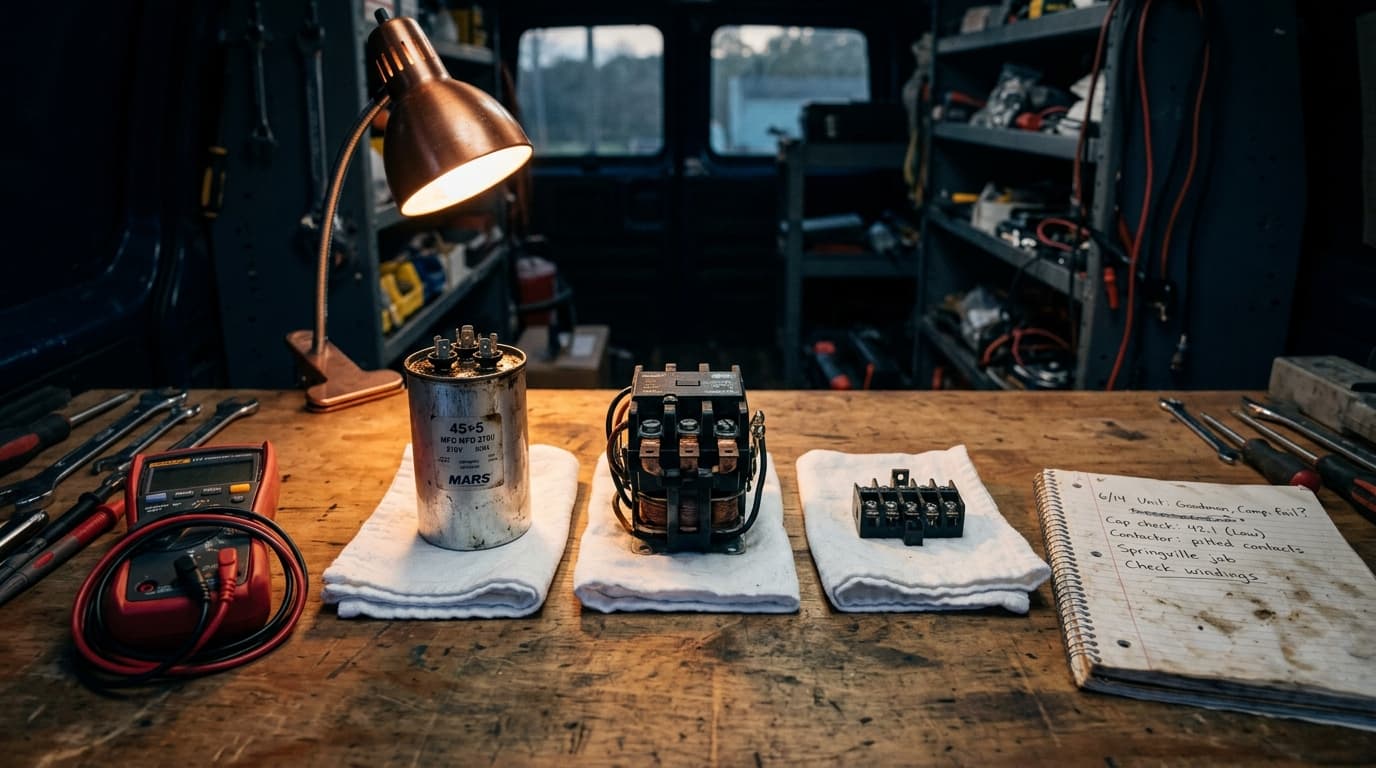
BLUF: about 70 percent of Springville AC repair calls in summer fall into three buckets. Failed dual-run capacitor (40 percent). Burned or pitted contactor (15 percent). Compressor issues — hard-start, low charge, or end-of-life (15 percent). The capacitor is the cheapest and fastest fix. The contactor is in the middle. The compressor is the expensive conversation. Knowing the symptoms before you call helps you tell whether the technician is being straight with you or padding the bill.
The Three Parts in Plain English
Look. You do not need to know HVAC. But knowing what these three parts do makes you a smarter customer. Five minutes of reading saves you from being upsold on the wrong fix.
The capacitor. Think of it as a tiny battery that gives the compressor and outdoor fan motor a hard kick when they start, and a steady push while they run. It is a cylindrical metal can about the size of a soda can. It sits in a small compartment on the side of the outdoor unit, held in place with a metal strap. When it dies, motors cannot start — they just hum.
The contactor. A small electromagnetic switch that connects 240-volt power to the compressor and fan motor whenever the thermostat calls for cooling. It is a square black box with copper contacts inside. When the thermostat sends 24-volt signal, the contactor pulls in and closes the circuit. When the contacts pit or burn, current cannot flow and the outdoor unit stays dead silent.
The compressor. The heart of the system. A sealed pump that circulates refrigerant through the loop. It is the largest, heaviest, most expensive part in the outdoor cabinet — a thick steel cylinder welded shut at the factory. It either runs, runs hard, or it does not run. When it dies, the system is mostly dead.
Scenario 1: Capacitor Failure
The most common Springville summer call. About 40 percent of failures.
What you see and hear:
- Indoor air handler running, blowing room-temperature or barely-cool air.
- Outdoor unit silent or making a low humming/buzzing noise.
- Outdoor fan blade not spinning, or wobbling slowly.
- Sometimes a faint clicking sound every few seconds — the system trying to start over and over.
- Top of the cabinet hot to the touch (refrigerant pressure rising with nowhere to go).
What is happening: The dual-run capacitor lost capacitance. Without the kick it provides, the compressor cannot start and the fan cannot start. They sit there pulling current but not moving.
What to do: Cut power at the outdoor disconnect or breaker. Every minute the compressor sits in locked rotor pulls high amperage and stresses the windings. Then call. This is a 20-minute fix once a technician is on site. Most Springville trucks stock the common capacitor sizes (35/5, 40/5, 45/5, 50/5, 60/5, 70/5, 80/5 microfarad).
Why it happens in Springville: heat. A capacitor rated for 70 degrees ambient lives a quarter as long at 90. Springville summer cabinet temperatures regularly hit 130 to 140 degrees on the south side of a house. Capacitors fail in 4 to 7 years instead of the rated 10. See AC Making a Loud Humming Noise for the audio diagnosis side.
Scenario 2: Contactor Failure
Second most common in Springville. About 15 percent of summer calls.
What you see and hear:
- Complete silence at the outdoor unit. No hum, no buzz, no fan motion.
- Indoor air handler runs normally — just no cooling.
- If contacts are welded closed, the opposite: outdoor unit running continuously even when thermostat is off.
- Sometimes a chattering or rapid buzz from inside the cabinet if the coil is failing but not gone.
- Visual inspection (panel off): burned contacts, ant carcasses, pitted copper, or a melted plastic housing.
What is happening: Three modes. One: contacts pitted from years of arcing each time the system cycles — eventually current cannot flow. Two: insect contamination — ants love the warm hum of the coil, crawl in, get fried across the contacts. Three: power surge welded the contacts together so they cannot release.
What to do: Cut power, call. Thirty-minute fix. Contactors are standard truck stock in 30-amp and 40-amp varieties for single and double pole. We bring two or three on every Springville call because it is the second-most-likely failure.
Why it happens in Springville: Springville has more open land than Birmingham proper. More insects. More ants. Springville also gets hit hard with summer storm surges that come down from Mountain Brook Country Club area and roll east. Those surges weld contacts. See also AC Not Working After Power Outage for the surge-damage scenario in detail.
Scenario 3: Compressor Issues
The expensive conversation. About 15 percent of calls, but accounts for most of the repair dollars.
Three sub-scenarios within compressor issues:
Sub-scenario A: Hard-start condition. The compressor still runs but pulls high amperage at startup and labors. Symptoms: lights dim briefly each time the AC kicks on, breakers trip occasionally during startup, the compressor sound is rough or labored. Fix: hard-start kit ($25 to $40 part, 30 minutes of labor). Buys two to four years on a marginal compressor. About 30 percent of Springville hard-start cases respond and run for years afterward.
Sub-scenario B: Low refrigerant charge. A slow leak somewhere in the system has dropped charge. Compressor runs but cannot produce cooling. Symptoms: long run times, high indoor humidity, ice on the suction line at the outdoor unit, suction pressure low on the gauges. Fix: find and repair the leak (variable cost depending on location and severity), evacuate, recharge with proper refrigerant per EPA Section 608. This is licensed-technician-only work.
Sub-scenario C: Dead compressor. Open windings, short to ground, or mechanical seizure. Symptoms: outdoor fan spins normally, no compressor sound, no cooling. Confirmed with megohm meter and continuity check. Fix: compressor replacement (expensive) or system replacement (more expensive but often the right call on 12-plus-year-old units).
For the repair-vs-replace conversation on older systems, see Ductless Mini-Split vs Central AC in Alabama and AC Installation Service.
How a Technician Tells Them Apart
Five minutes with a multimeter and a stethoscope. The diagnostic sequence:
- Listen at the cabinet. Silent = contactor or upstream power. Humming = capacitor or compressor. Chattering = failing contactor.
- Voltage incoming. 240V at the disconnect lugs? Yes — problem is inside. No — problem is upstream (breaker, wiring, disconnect itself).
- Low-voltage signal. 24V across Y terminal at contactor? Yes — thermostat is calling, contactor is the suspect. No — problem is at the thermostat or transformer.
- Contactor pull-in test. Manually push the contactor plunger with an insulated tool (power off). Listen for the compressor to attempt start when power restored. If it attempts start, contactor was the problem.
- Capacitor microfarad test. Discharge first. Read with a meter. Compare to nameplate spec. Anything more than 10 percent low is failed.
- Compressor continuity. If contactor and capacitor are good and the compressor still does not run, check windings (Start, Run, Common terminals) for continuity. Open winding = dead compressor.
- Compressor amp draw under load. If it runs, amp draw should be at or below nameplate FLA. Higher = hard start, low charge, or pending failure.
Per Department of Energy maintenance guidance, proper diagnostic readings separate a real repair from a guess. Any technician who skips the meter and pushes a part replacement is guessing — and guessing wrong costs you money.
Honest Pricing Framing
You will notice I am not putting dollar amounts in this article. Two reasons.
One: pricing varies by system, brand, refrigerant, and access. A capacitor swap on a ground-level Goodman is faster than a capacitor swap on a rooftop Trane buried under solar panels. The honest answer is to give a written estimate based on what we actually see.
Two: the published pricing on competitor sites is mostly marketing. Real Springville pricing falls into clear tiers — capacitors at the small end, contactors in the middle, compressors and refrigerant work at the big end. What matters is the written estimate before any tool comes out of the bag, and no surprise invoice at the end.
If a technician quotes any of these scenarios over the phone without seeing the system, they are guessing. If they quote a price more than 3x the standard tier, get a second opinion. Most Springville homeowners can call two technicians for diagnosis before committing to a repair on the bigger jobs.
Preventing All Three
Real prevention is boring. It is also the difference between a five-year capacitor and a seven-year capacitor, and between a fifteen-year compressor and an eight-year compressor.
- Annual spring inspection. Tests capacitor microfarads against spec. Inspects contactor visually for ants and pitting. Reads compressor amperage under load. About a 45-minute visit. Catches 80 percent of pending failures before they become a 2 AM emergency.
- Keep the outdoor coil clean. A clean coil means lower head pressure, lower amperage, and lower component stress. Hose down the fins twice a year. Clear two feet around the unit.
- Surge protection. A whole-house surge protector at the panel is about $250 installed. Pays for itself the first summer storm that would have welded your contactor.
- Replace the filter every 1 to 3 months. Clean filter means proper airflow means proper refrigerant temperatures means less stress on the compressor.
- Treat for ants. Granular ant bait around the outdoor unit twice a year. Prevents the most common contactor failure in rural Springville.
For Springville-specific service area details, see Springville HVAC Coverage. For sister coverage in Leeds, Moody, and Clay. For the related symptoms-and-diagnosis articles see AC Tripping Breaker, AC Making a Loud Humming Noise, and Leeds 2 AM AC Failure Checklist.
Springville AC down?
Phone triage first — about a third of calls clear before the truck rolls.
Call (205) 206-5252Byline: John, licensed Alabama HVAC technician. 25 years in the east corridor — Leeds, Moody, Pinson, Clay, Springville, Trussville. Bonded and insured. EPA Section 608 Universal.
Citations: U.S. Department of Energy — Maintaining Your Air Conditioner · ENERGY STAR Heating and Cooling · EPA Section 608 Refrigerant Regulations