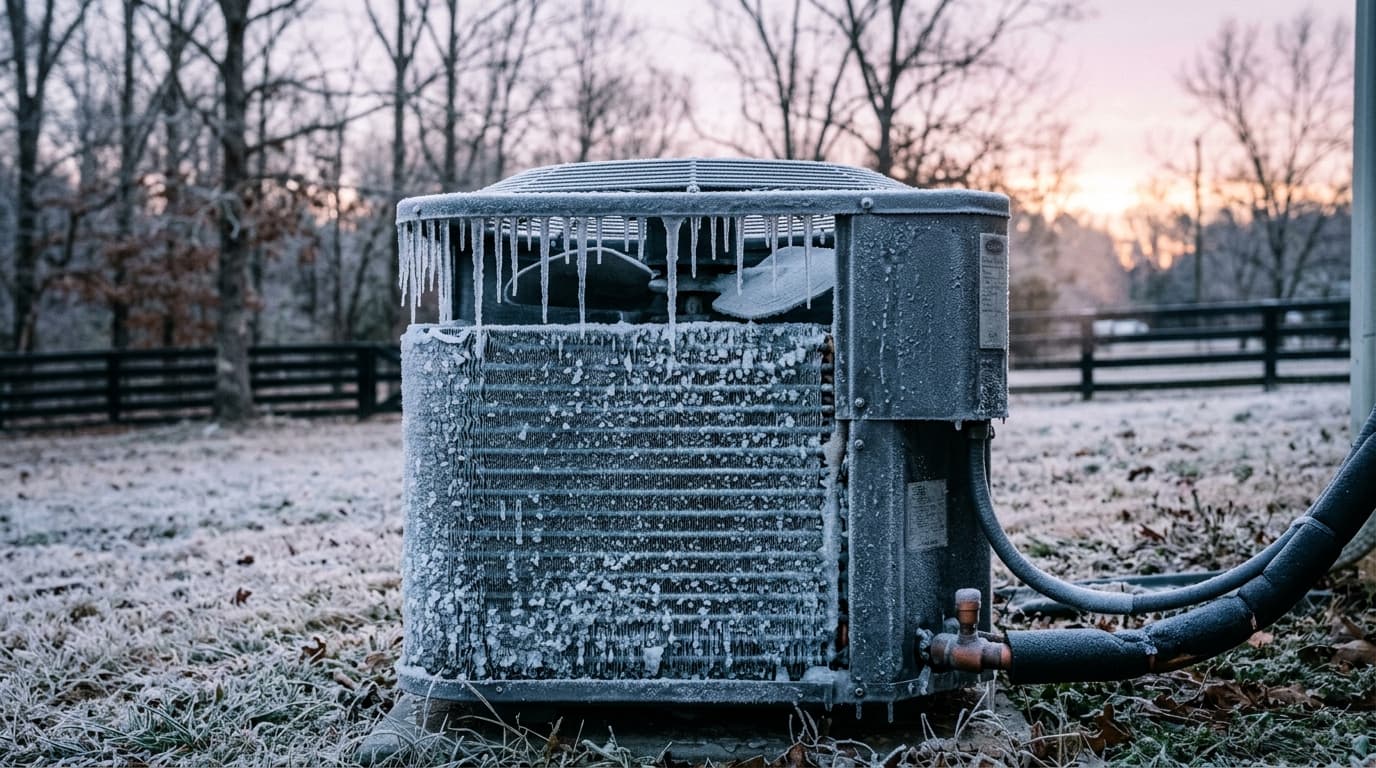
BLUF: a heat pump in defrost mode for more than 15 minutes is a stuck defrost cycle, not a long one. Most common cause in Pinson is a failed defrost sensor or a stuck reversing valve. Switch the thermostat to Emergency Heat to keep the house warm, kill power at the outdoor disconnect to stop the unit from cycling, and call in the morning unless you have a vulnerable family member or the indoor temp is dropping below 60. Never pour hot water on the iced-up coil — it warps the aluminum fins.
How Heat Pump Defrost Actually Works
Here is what is going on inside the outdoor cabinet. In heating mode, your heat pump pulls heat out of the outdoor air and pumps it into the house. To do that, the outdoor coil runs colder than the outside air — sometimes 15 to 20 degrees colder. When outside humidity hits that cold coil, water vapor freezes onto the fins as frost.
Frost insulates the coil. An insulated coil cannot absorb heat from outside air. So the system runs a defrost cycle: it reverses the refrigerant flow temporarily — running in cooling mode for a few minutes — which pumps hot refrigerant through the outdoor coil and melts the frost. The outdoor fan shuts off during defrost so it does not blow the warm refrigerant away.
You will see white steam rising off the outdoor unit during a normal defrost cycle. The indoor air handler keeps blowing — but the air coming out feels room-temperature or slightly cool because the system is briefly in cooling mode. Most systems also energize the auxiliary electric heat strips during defrost so the indoor air does not actually feel cold.
A normal Pinson defrost cycle takes five to fifteen minutes. Time-temperature defrost boards run every 30, 60, or 90 minutes depending on outdoor temperature. Newer demand defrost boards run only when actual frost is detected. Either way, the system should return to heating mode quickly.
Why It Locks In Defrost
A stuck defrost cycle has a handful of common causes:
- Failed defrost sensor. The thermistor that tells the board the coil is clear gives a false cold reading. Board thinks the coil is still frosted and stays in defrost. Most common cause in 10-plus-year-old Pinson systems.
- Stuck reversing valve. The valve that switches the system between heat and cool is stuck halfway. System runs in a no-mans-land — neither full cooling nor full heating. Solenoid coil failure or a mechanical hang.
- Failed defrost control board. Capacitors on the board age out, relays stick, sometimes a power surge damages the logic. Whole board replacement.
- Low refrigerant charge. System cannot build enough pressure to push frost off the coil. Defrost cycle runs longer and longer trying to clear frost that will not clear.
- Iced-over coil from prior failure. If the system ran for hours in heat mode with low refrigerant or a broken defrost system, the coil can build up an inch of ice that no normal defrost cycle can melt. Unit has to be powered down and thawed.
About 60 percent of Pinson defrost-lock calls in winter are failed defrost sensors. Another 20 percent are stuck reversing valves. The rest is a mix.
Why Pinson Sees This More
Pinson sits in a microclimate that is a little colder and wetter than Birmingham proper. The elevation difference is small, but the area off Highway 75 and out toward Clay holds morning humidity longer than the city center. That means more frost on outdoor coils, more defrost cycles, and more stress on the defrost control system.
A lot of Pinson homes built between 1990 and 2010 also have heat pumps that are now at 15 to 25 years old. The defrost sensors on those units are at the end of their service life. Five Pinson winters of constant defrost cycling adds up.
Pinson and Clay together account for a meaningful share of east-corridor winter calls — see Clay Heat Pump — Ice On Outdoor Coil at 2 AM for the sister failure pattern.
Safe Homeowner Checks
Before you call, three checks. Five minutes. All safe to do without tools.
- Thermostat display. Does the screen say Defrost, Aux Heat, or just Heat? If it says Defrost: time how long the icon has been showing. Under 15 minutes is normal. Over 15 minutes is stuck.
- Visual at the outdoor unit. Walk outside (carefully, ice). Is the outdoor fan spinning? In defrost mode it should be off. Steam should be rising. After 10 minutes the fan should restart. If the fan is off and the coil still looks frosted after 20 minutes, the cycle is stuck.
- Indoor vent temperature. Hold your hand under a supply vent. Air should be warm (90 to 105 degrees) in normal heat. Cool (50 to 65 degrees) during a brief defrost cycle. Cold (under 50) for more than 15 minutes means the reversing valve may be stuck in cooling.
If any of those are wrong, switch the thermostat to Emergency Heat.
Switching to Emergency Heat
On most thermostats, there is a separate mode called Emergency Heat, Aux Heat, or Em Heat. Select it. The system will stop trying to run the outdoor heat pump and rely entirely on the indoor auxiliary electric heat strips.
Per U.S. Department of Energy heat pump guidance, emergency heat costs two to three times as much per kWh of heat output as normal heat pump operation. You do not want to run it for weeks. But for one night while waiting on a service call, it keeps the house warm and stops the stuck defrost cycle from damaging the system further.
Confirm the strips are working by waiting 60 seconds, then checking a supply vent. Air should be warm within two minutes.
How To Safely Thaw the Coil
If the outdoor coil is encased in a thick layer of ice — more than a quarter-inch on the fins — it needs to thaw before the system can run normally again. Two safe methods:
- Passive thaw. Kill power at the outdoor disconnect. Let the unit thaw naturally. Takes two to four hours in 30-degree weather, longer if colder. Cover with a tarp if rain is coming so it does not re-freeze.
- Garden hose with cool water. Cool tap water only — never hot. Gentle spray across the coil from a foot away. Speeds the thaw to 30 to 60 minutes. Make sure power is off first.
Once the coil is clear and you can see the fins, leave power off and call. Do not restart the system until a technician has identified why it iced over in the first place — restarting on a broken defrost system will just re-ice within hours.
Three Things That Wreck a Heat Pump
- Pouring hot water on the coil. Thermal shock warps the aluminum fins, sometimes cracks copper refrigerant tubing. Hundreds of dollars in coil damage to save four hours of thaw time.
- Chipping ice off with a hammer or screwdriver. The fins bend at the slightest contact. A bent fin reduces airflow and accelerates the next freeze.
- Running the system in heat mode with the coil iced up. Forces the compressor against locked refrigerant pressure. Pulls high amperage. Cooks the compressor windings. A $300 defrost board fix becomes a $2,500 compressor replacement.
When This Becomes an Emergency
Call as a real emergency — not next morning — if any of these apply:
- Indoor temperature dropping below 60 degrees and continuing down.
- Emergency heat strips are not coming on either (no warm air from vents in any mode).
- Burning smell from the air handler when emergency heat is running.
- Smoke or sparks from the outdoor unit or disconnect.
- Vulnerable family members — infants, elderly, anyone with cardiovascular conditions — in the house.
Per National Weather Service cold weather guidance, indoor temperatures below 60 degrees overnight pose serious health risks for older adults and infants. Do not wait until morning if the house is cooling fast.
For broader Pinson winter coverage and our service area, see Pinson HVAC Coverage. For the cousin failure mode in Clay, see Clay Heat Pump — Ice On Outdoor Coil at 2 AM. For summer-side emergencies see Leeds 2 AM AC Failure Checklist. For the call-vs-DIY decision, see When to Call for Emergency AC Repair vs DIY.
Pinson heat pump locked in defrost?
Switch to emergency heat first. Then call John for service.
Call (205) 206-5252Byline: John, licensed Alabama HVAC technician. 25 years in the east corridor — Leeds, Moody, Pinson, Clay, Springville, Trussville. Bonded and insured.
Citations: U.S. Department of Energy — Heat Pump Systems · ENERGY STAR Heat Pumps · National Weather Service Cold Weather Safety