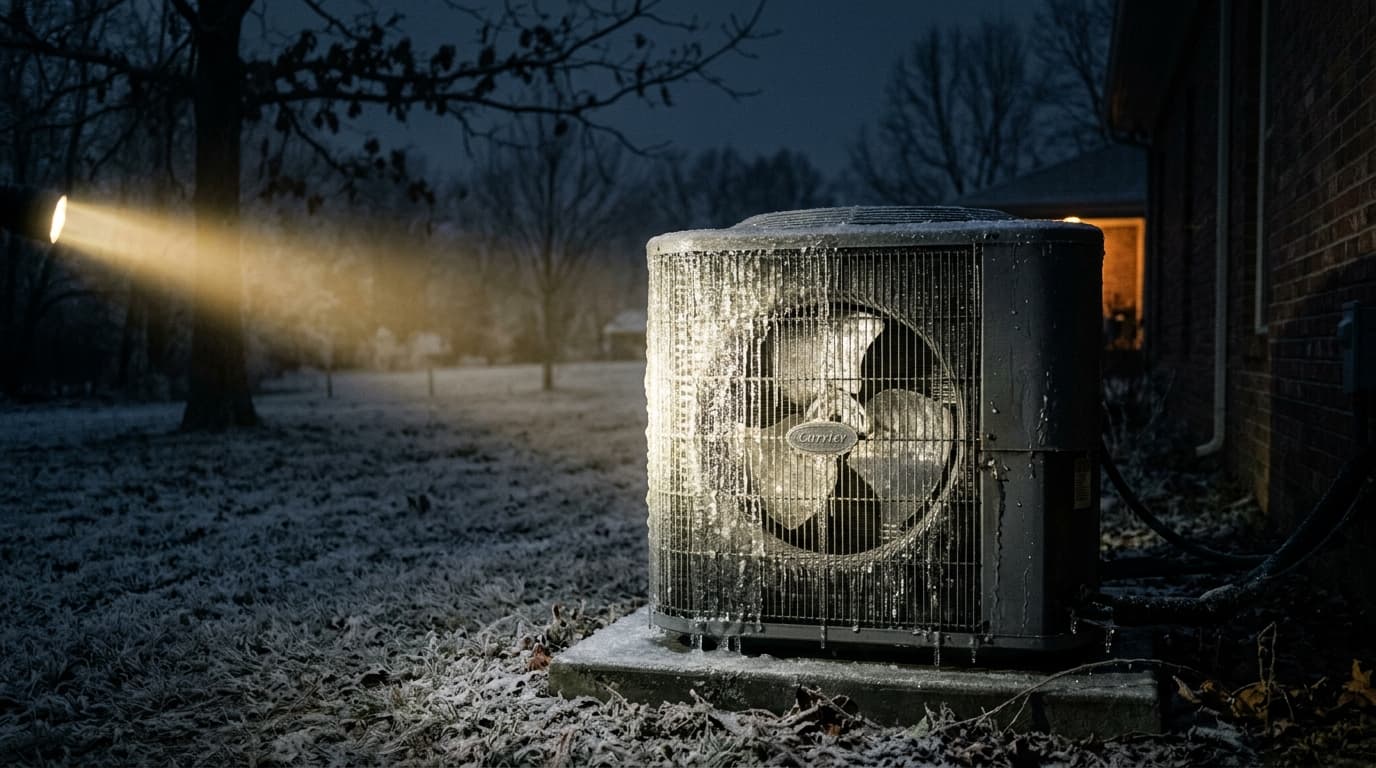
BLUF: a heat pump iced over at 2 AM is a defrost system that failed sometime in the last 12 hours, a low refrigerant charge, or blocked airflow at the outdoor unit. Three-step homeowner response right now: switch the thermostat to Emergency Heat, kill power at the outdoor disconnect, leave the unit to thaw on its own until morning. Do not pour hot water on it, do not chip ice off with anything sharp, do not restart the system until a technician finds the root cause.
The Three Causes of Midnight Ice-Ups
When a heat pump in Clay ices up at 2 AM, the cause is almost always one of three things. The technician finds out which one in the morning. You do not need to diagnose it tonight — you just need to keep the system from damaging itself further.
Cause one: defrost system failure earlier in the day. Maybe the defrost board failed at noon. Maybe the defrost sensor went bad at 6 PM. Either way, the system stopped running its defrost cycles and frost accumulated over six to twelve hours into a solid ice block. By 2 AM the coil is encased.
Cause two: low refrigerant charge. A slow leak you did not know about dropped the system below proper charge. Lower refrigerant pressure means the coil runs even colder than usual — sometimes 10 to 20 degrees below freezing instead of 5. Defrost cycles cannot melt that much frost. The coil ices over despite the system trying.
Cause three: blocked airflow. Leaves piled against the side of the unit. A tarp left over the cabinet (homeowners do this in fall and forget). Heavy snow piled against the coil. Anything that stops air from flowing through the fins means heat cannot be absorbed and frost cannot be cleared. In Clay this is especially common because of pine and oak debris in fall.
Why Clay Sees This More Than Birmingham
Clay sits in a slightly colder microclimate than the city proper. The combination of elevation, tree cover, and proximity to the Cahaba watershed means overnight temperatures in Clay run two to four degrees colder than Birmingham downtown in winter. That extra few degrees pushes a marginal heat pump from working to icing up.
A lot of Clay homes also have heat pumps that were installed during the 1995 to 2010 building boom — Highway 75 corridor neighborhoods especially. Those systems are now 15 to 25 years old. Defrost boards, defrost sensors, and reversing valves all have a service life around 12 to 18 years. They are reaching the end of that window all at once.
And Clay has a lot of pine trees. Pine needles get into outdoor units year-round, but in fall they pile up against the cabinet and block airflow. That is the third cause of ice-ups, and it is preventable with a five-minute walk-around once a month. See also Pinson Heat Pump Defrost Lock for the sister failure pattern in the next zip code over.
What To Do In The Next Ten Minutes
Three steps. In order. No tools needed.
- Switch the thermostat to Emergency Heat. The auxiliary electric heat strips will take over heating the house. Air from the vents should feel warm within two minutes. Indoor temperature will hold steady or rise overnight.
- Kill power at the outdoor disconnect. That gray box next to the condenser. Pull the fuse block out or flip the switch to OFF. This stops the compressor from cycling against a frozen coil — which is what causes compressor damage. Even with the thermostat in Em Heat, some systems will still energize the outdoor unit. Killing the disconnect guarantees it is off.
- Walk away. Go back to bed. The thaw will happen on its own as temperature rises in the morning. Trying to speed it up in the dark with cold hands risks bending fins or worse.
That is it. Ten minutes of work and the system is safe overnight.
The Safe Overnight Thaw Procedure
With power off and the thermostat in Em Heat, the iced coil will thaw passively. Speed depends on overnight temperature:
- 30 to 40 degrees overnight. Passive thaw in 4 to 8 hours. Should be liquid water by sunrise.
- 20 to 30 degrees overnight. Passive thaw in 8 to 16 hours. May still have ice patches at sunrise — wait until temperature rises above 35.
- Below 20 overnight. Passive thaw essentially does not happen. You will need afternoon temperatures or a controlled thaw in the morning.
In the morning, if temperature is above 40 and the coil still has heavy ice, a gentle spray of cool water from a garden hose accelerates the thaw to 30 to 60 minutes. Cool tap water only — never hot, never boiling, never warm. Per Department of Energy guidance on heat pump systems, aluminum coil fins are extremely sensitive to thermal shock. Hot water cracks them. Cool water does not.
Three Things That Will Wreck The System
- Hot or boiling water on the coil. Thermal shock cracks aluminum fins, warps copper tubing, and can cause refrigerant leaks. A $300 defrost board fix becomes a $1,500 coil replacement.
- Chipping ice with a screwdriver, hammer, or anything sharp. Fins bend on contact. Bent fins reduce airflow by 20 to 40 percent. Reduced airflow guarantees the next ice-up.
- Running the system in heat mode while iced. Compressor pulls high amperage against locked refrigerant pressure. Windings overheat. Hard-start kit eventually fails to save it. Compressor replacement is the most expensive single repair on a residential heat pump.
What To Do In The Morning
Wait until afternoon if temperature is below 35. Once the coil is clear of ice and you can see the fins, walk around the unit and check:
- Any debris around the unit — leaves, pine needles, tarps. Clear two feet on all sides.
- The fan blade — should spin freely by hand. Bent or wobbly is a flag.
- Fin condition — straight or bent? Severely bent fins reduce capacity.
- Refrigerant line insulation — torn or missing on the suction line speeds ice-up.
- Any oily residue around the unit base — sign of refrigerant leak.
Then call. Do not restart the heat pump on your own. Run the house on Emergency Heat until a technician identifies the root cause and confirms the system is safe to restart in normal mode.
Preventing The Next Ice-Up
Three habits will catch most Clay ice-ups before they happen:
- Monthly walk-around. Five minutes. Clear leaves, debris, any tarp or cover (manufacturers do not recommend covers on heat pumps anyway — they trap moisture). Pull back any vegetation within two feet.
- Fall maintenance call. Before the first hard freeze, a technician checks defrost sensor, defrost board operation, refrigerant charge, contactor, and capacitor. About a 45-minute visit. Catches almost all the failures that cause midnight ice-ups in January.
- Pay attention to defrost cycle behavior. If you notice the system running unusually long defrost cycles in November and December, or unusual icing during normal weather, call before the cold snap. Marginal defrost components fail at the worst time. Fix them when it is convenient.
See also Pinson Heat Pump Defrost Lock for the related defrost-stuck scenario, Heat Pump vs Traditional AC in Cooling Mode for summer-side coverage, and When to Call for Emergency AC Repair vs DIY for general call-vs-wait decisions. Clay coverage details: Clay HVAC Service Area. For sister coverage in Pinson and Leeds.
Clay heat pump iced over?
Em Heat on. Disconnect off. Then call John in the morning.
Call (205) 206-5252Byline: John, licensed Alabama HVAC technician. 25 years in the east corridor — Leeds, Moody, Pinson, Clay, Springville, Trussville. Bonded and insured.
Citations: U.S. Department of Energy — Heat Pump Systems · ENERGY STAR Heat Pumps · National Weather Service Cold Weather Safety