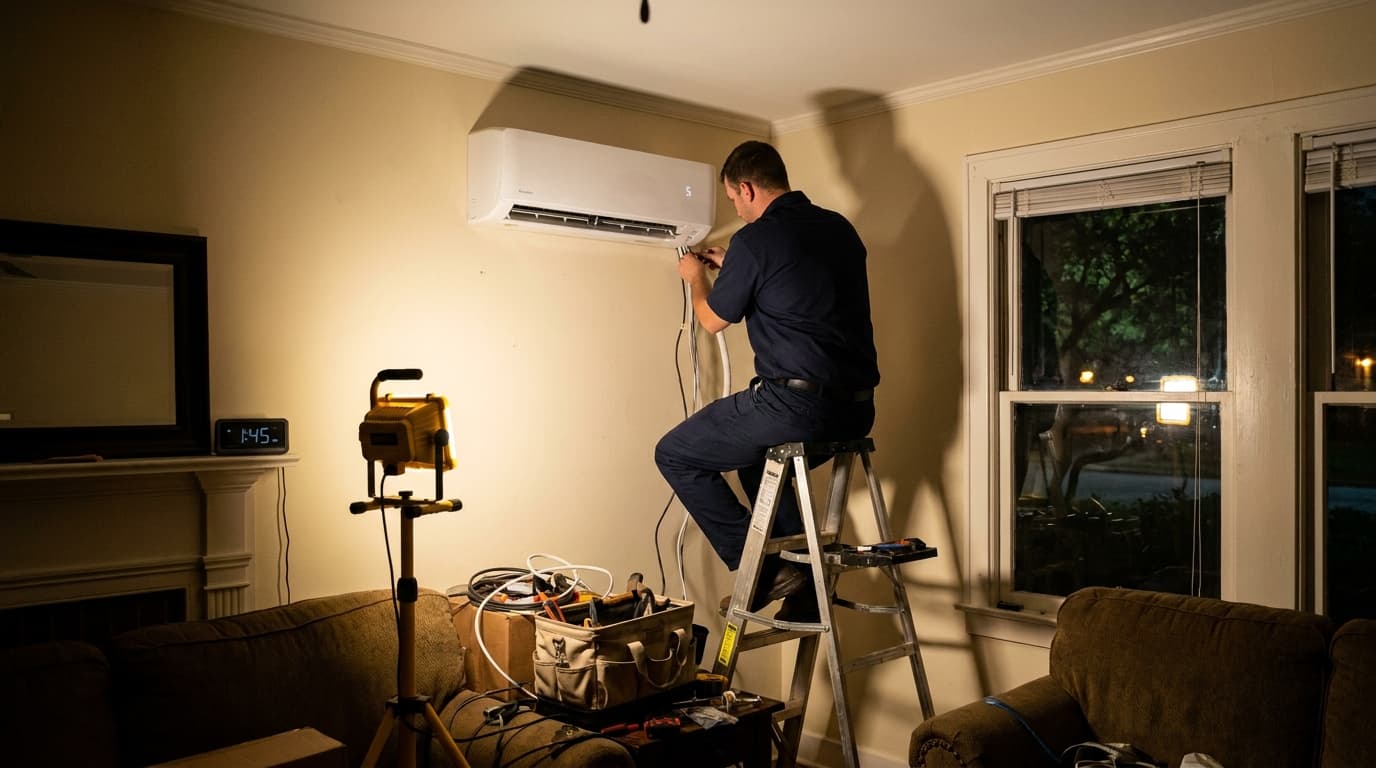
BLUF: in Alabama's mild winters and hot humid summers, a heat pump is the right default for new installations. You get equal or better cooling than traditional AC, efficient heating without gas furnace equipment, and one system to maintain instead of two.
What Actually Changes When You Add the Reversing Valve
A heat pump is architecturally nearly identical to a traditional split-system AC. Both have an outdoor condenser unit, an indoor air handler with an evaporator coil, a compressor, a metering device, and refrigerant lines connecting everything. The only substantive addition in a heat pump is a four-way reversing valve that lets the refrigerant flow direction flip, turning the outdoor unit into a heat source and the indoor coil into a heat rejecter during winter operation.
In cooling mode, the reversing valve is static — refrigerant flows the same direction it would in a traditional AC. There is no efficiency cost, no capacity cost, no reliability cost during cooling operation. The valve only does work when the system is called to heat.
Cooling-Mode Efficiency Comparison
Per U.S. Department of Energy, heat pump cooling mode SEER2 ranges match traditional AC class by class. 2024 federal minimums are 15.2 SEER2 for heat pumps and 15.0 SEER2 for traditional AC. Premium residential models reach 22 SEER2 on both sides. For a given efficiency tier, cooling costs are equivalent.
Where heat pumps pull ahead is when inverter-driven variable-capacity compressors are compared against single-stage traditional AC. Inverter heat pumps modulate compressor output from 30 to 100 percent of rated capacity, matching output to actual load. This produces longer run times at lower capacity, which dehumidifies better, maintains tighter setpoint control, and reduces peak electrical demand.
Humidity Control — The Alabama Advantage
Alabama summers run 80+ percent humidity. Dehumidification performance is frequently more important for actual comfort than temperature accuracy. Inverter heat pumps outperform traditional single-stage AC for humidity control because they run continuously at partial capacity rather than cycling on and off. Continuous operation means continuous condensation on the evaporator coil, which means continuous moisture removal.
For homeowners currently struggling with a house that reads 72°F but feels clammy, replacing an oversized single-stage AC with a properly sized variable-capacity heat pump often solves the humidity complaint without needing to add a separate dehumidifier. The inverter modulation effectively converts the cooling system into a dehumidification-first appliance. See our humidity problem article for the underlying physics.
Heating Performance in Alabama Winter
Alabama's winter temperature profile is where heat pump economics really win. Per NOAA climate data, Birmingham-area winter lows average 33°F in January and rarely break below 15°F. Heat pumps operate at full capacity above 17°F and at reduced (but still meaningful) capacity below that. Supplemental electric strip heat is available for the rare sub-15°F mornings, and most heat pumps in Alabama homes run strip heat less than 40 hours per year total.
HSPF2 (Heating Seasonal Performance Factor 2) is the heating efficiency metric. Federal minimum is 7.5 HSPF2 for residential split systems. Premium models hit 10.5. At 8.5 HSPF2, a heat pump delivers about 2.5 units of heat energy per unit of electrical input — meaningfully better than electric resistance heat at 1.0 and competitive with or better than gas furnaces at 92 to 98 percent AFUE when accounting for Alabama's electricity and gas pricing.
Per Energy.gov, a heat pump reduces electrical heating consumption by 50 to 60 percent compared to resistance heating. For homes currently using electric furnaces or electric strip baseboards, a heat pump retrofit is one of the highest-ROI HVAC upgrades available.
What It Actually Costs
Per HomeGuide 2024 national averages, a complete heat pump system installation runs $8,000 to $14,000 depending on tonnage, SEER2 rating, and indoor-unit type. Traditional split-system AC replacement runs $5,000 to $10,000 for comparable cooling capacity, but that price assumes retaining the existing gas furnace or electric strip heat setup.
The comparison tightens when accounting for full system replacement. Replacing a 15-year-old gas furnace AND a 15-year-old AC with two new pieces of equipment runs $8,000 to $16,000. Replacing both with a single heat pump runs $8,000 to $14,000 and eliminates future gas furnace maintenance. Over a 15 to 20 year service life, the single-system approach typically costs less.
Brand Recommendations for Birmingham
For traditional split-system heat pumps, Trane, Carrier, Lennox, Rheem, and Bryant all offer variable-capacity residential models with strong Alabama parts networks. Trane XV20i and Carrier Infinity 24VNA are the premium variable-capacity options with AHRI-listed 20+ SEER2 ratings when paired correctly.
For ductless heat pumps, Mitsubishi M-Series is the east-corridor default. Daikin Aurora offers the best cold-climate performance if that matters for your specific location. Fujitsu Halcyon delivers the quietest indoor operation. See our manufacturer matrix for brand-by-brand detail or our ductless brand comparison.
Maintenance Differences
Heat pumps require the same annual maintenance as traditional AC — coil cleaning, pressure check, electrical tightening, refrigerant charge verification. The added consideration: heat pump systems have an outdoor defrost cycle that activates in winter when outdoor coil ice forms. A failed defrost control board, sensor, or reversing valve solenoid causes the system to run in cooling mode during heating calls or to ice up catastrophically during cold mornings. These are specific heat-pump failure modes that require heat-pump-specific diagnostic experience.
Our heat pump repair service covers reversing valves, defrost boards, balance-point calibration, and strip-heat integration. See heat-pump case studies for real east-corridor repair examples.
Bottom Line
For new installations in the east corridor, a heat pump is the right default. Cooling performance equals or beats traditional AC, heating performance is strong for Alabama winter, and one system replaces two. The only scenario where traditional AC still wins is a homeowner replacing only the AC side of a split system with a recently replaced gas furnace — in that case, keep the working furnace and replace the AC with a matched traditional unit. For full-system replacements or new construction, default to heat pump.