Bottom line up front:Central AC is the right choice when your home has existing ductwork in good condition and you need whole-home conditioning. Ductless (mini-split) is the right choice for garages, detached workshops, historic homes without ductwork, bonus rooms over garages, and any space the central system cannot efficiently reach. In Birmingham's east corridor, the most common correct answer is both — central for the house, ductless for the garage or addition.
How each system works.
Central AC uses a single outdoor condenser and an indoor air handler connected to the conditioned space through a network of ducts. The air handler pulls warm air in through return ducts, cools it across a refrigerant-charged evaporator coil, and distributes the cooled air through supply ducts to every room with a register. A single thermostat controls the entire system. The efficiency loss in this process comes primarily from the duct network — the U.S. Department of Energy estimates that duct losses account for 20–30% of total cooling energy in a typical home through leaks, conduction through uninsulated duct surfaces, and friction losses.
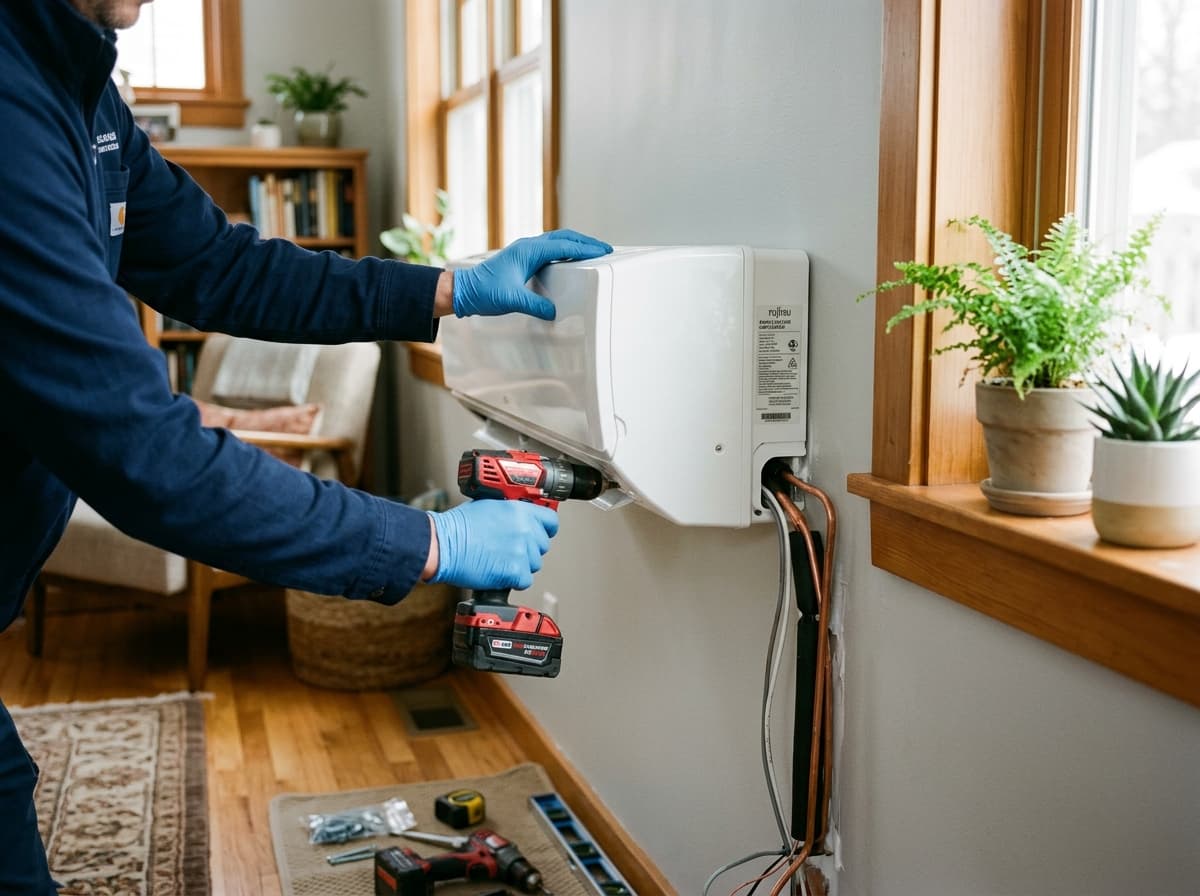
A ductless mini-split moves the refrigerant directly to the space being cooled instead of moving air through ducts. An outdoor condenser connects to one or more indoor air-handling heads through a small refrigerant line set that runs through a 3-inch wall penetration. Each indoor head contains its own fan, evaporator coil, and controls, and conditions only the room it is mounted in. There are no duct losses. Variable-speed inverter compressors modulate output based on real-time demand rather than cycling on and off at full capacity, which produces the 18–24 SEER efficiency ratings common in modern mini-split equipment — compared to 14–16 SEER for most builder-grade central systems.
The east-corridor decision framework.
Use this table for your specific situation. If your situation appears in the ductless column, a mini-split is almost certainly the right answer for the Birmingham market.
| Your Situation | Central AC | Ductless |
|---|---|---|
| Whole home, existing ducts in good condition | ✓ Best choice | Not needed |
| Detached garage or workshop | Not practical (no ducts) | ✓ Best choice |
| Historic home, no existing ductwork | Requires destructive install | ✓ Best choice |
| Bonus room over garage | Often undersized from existing trunk | ✓ Best choice |
| Sunroom or room addition | Complex to extend ductwork | ✓ Best choice |
| Two-story home with upstairs temp gap | Needs expensive zoning upgrade | ✓ Per-room heads fix it |
| Short-term rental, independent zones needed | Shared system risk | ✓ Independent control |
| Home gym or workshop in main house | Works if ducts reach it | ✓ Better zoning control |
Efficiency: what the numbers actually mean in Alabama.
A modern ductless mini-split rated 20 SEER uses roughly 30% less energy than a 14-SEER central AC system to move the same amount of heat. In Alabama, where the east-corridor cities of Leeds, Moody, Pinson, Clay, and Springville accumulate roughly 2,000–2,200 cooling degree-days per year and HVAC systems run 15–18 hours per day during July and August, that efficiency difference translates to meaningful monthly utility savings. According to U.S. Department of Energy, certified ductless systems can reduce cooling costs significantly compared to older or lower-efficiency central systems.
For a detached garage application specifically, the efficiency comparison is even sharper because the alternative is not central AC but a window unit — which operates at 8–12 EER (roughly 8–12 SEER equivalent) versus 18–24 SEER for a mini-split. A window unit also creates negative pressure in the garage by exhausting hot air outward, which pulls replacement hot air through every gap in the building envelope, effectively working against itself. A mini-split has no such problem. The efficiency advantage for garage applications is approximately 50–100% in favor of the mini-split.
Cost comparison for east-corridor Alabama.
According to HomeGuide and Energy.gov 2024 benchmarks, a single-zone ductless mini-split installation runs $2,000–$5,500 installed. A central AC system replacement runs $3,500–$7,500+ depending on the size of the home, equipment tier, and whether ductwork needs modification. For new construction without ductwork, adding a full duct system adds $2,000–$5,000 to central AC installation cost, which often makes ductless the more economical choice for smaller spaces.
| System | Typical Range | Best For |
|---|---|---|
| Ductless single-zone | $2,000–$5,500 | Garage, 1–2 rooms, no ducts |
| Ductless multi-zone (2–3 heads) | $5,000–$12,000 | Partial home, additions |
| Central AC replacement (existing ducts) | $3,500–$7,500 | Whole home with good ductwork |
| Central AC + new ductwork | $7,000–$15,000+ | New construction whole home |
Ranges from HomeGuide, Angi, and Energy.gov 2024. Not our prices — call (205) 206-5252 for a written estimate.
Ductless vs central — questions we hear.
Is ductless AC better than central AC in Alabama?
Neither is universally better. Central is the right choice for whole-home conditioning in homes with existing ductwork in good condition. Ductless is the right choice for garages, workshops, historic homes without ductwork, bonus rooms over garages, and multi-zone applications. In Alabama's east corridor, the most common correct answer is both systems serving different spaces.
What are the disadvantages of ductless mini-splits?
Higher upfront cost per zone than extending an existing central system, visible indoor head units in each room, filter cleaning every 1–3 months per head, and the need for separate outdoor equipment for each zone group. For whole-home applications in homes with good ductwork, central is typically more cost-effective.
How much more efficient is ductless than central AC?
Modern ductless mini-splits achieve 18–24 SEER vs 14–16 SEER for builder-grade central systems. Energy.gov estimates duct losses add 20–30% to central AC energy use. For Alabama homes running systems 15–18 hours per day in summer, the difference is meaningful in utility bills over the system's service life.
Can a heat pump replace both central AC and a mini-split?
A central heat pump handles whole-home heating and cooling through existing ductwork. A ductless mini-split is itself a heat pump for spaces without ducts. They serve different applications and are often installed together — central for the house, ductless for the garage or addition.