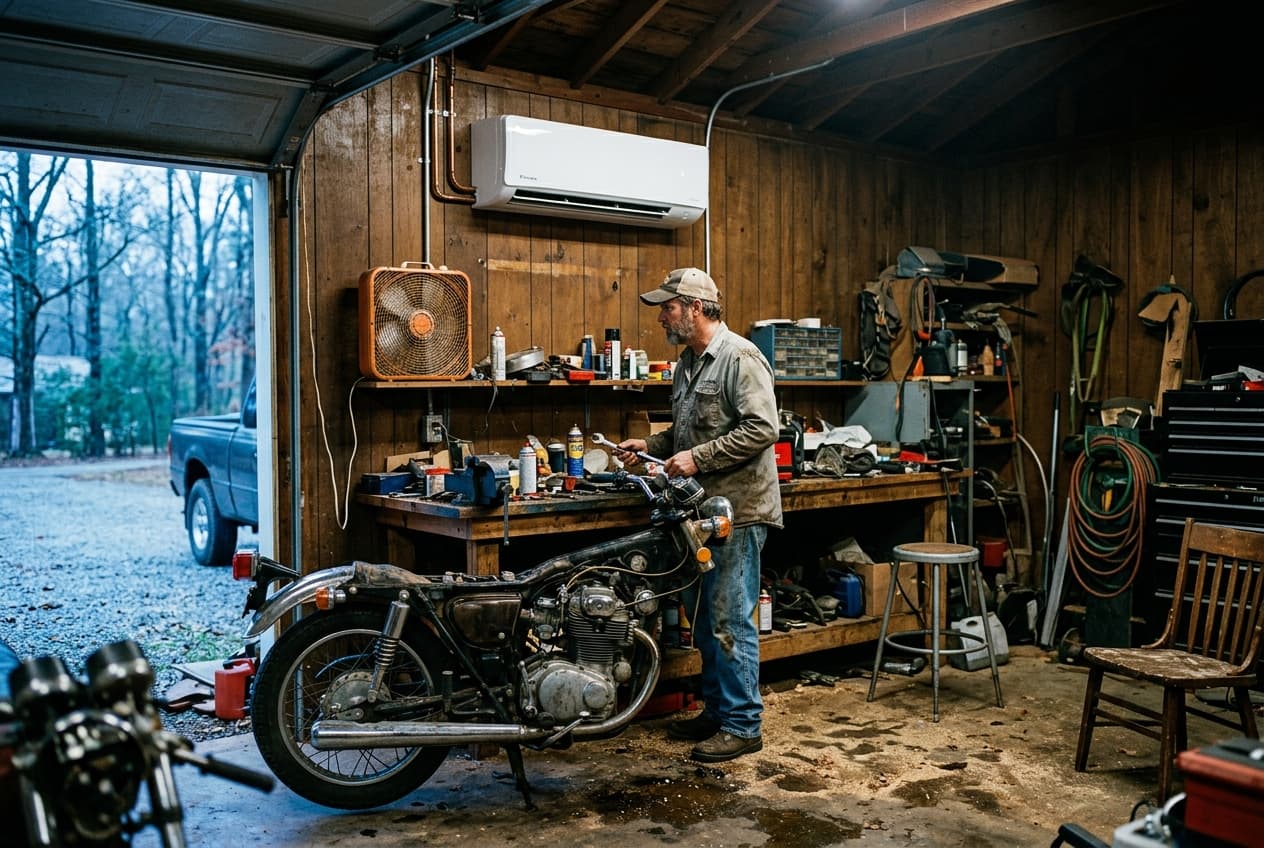
Why garages are hard to cool.
A Birmingham garage in July is effectively a heat accumulator. Uninsulated or lightly insulated walls take on direct solar gain all day, the metal garage door conducts heat directly through into the space, the concrete floor stores heat from morning through evening, and most garages have zero shade cover from trees or structures. Inside temperatures regularly exceed 110 degrees on clear July afternoons, even when the outdoor air temperature is only 95. Every extra 15 degrees inside the garage then radiates through the shared wall into your house, forcing the main HVAC system to work harder to keep the adjacent rooms at setpoint.
Most garages across the east corridor cities of Leeds, Moody, Pinson, Clay, and Springville share three characteristics that make them especially challenging to cool: a single uninsulated door that represents 40 to 60 square feet of steel exposed to direct sun, an uninsulated or lightly insulated attic above, and no mechanical ventilation. A typical 2-car garage in Alabama sees peak cooling loads of roughly 12,000 to 18,000 BTUs, which is substantially more than the square footage alone would suggest because of these envelope challenges.
The attempt to cool a garage with a single standard window unit is why so many homeowners give up. A 5,000 or 8,000 BTU window unit is designed for a residential bedroom of 150 to 350 square feet with insulated walls and ceiling. That same unit installed in a 2-car garage fights a thermal load three to five times larger than what it was designed for, runs continuously without getting the space cool, burns out within a few summers, and leaves the homeowner convinced that garage cooling is impossible. It is not impossible. It just requires properly sized equipment.
Ductless vs window unit vs portable.
Three equipment types could theoretically cool an Alabama garage. Only one actually works long-term.
The window unit path looks cheapest upfront, but the math does not work over a 10-year horizon. A $400 window unit that needs replacing three times equals $1,200 in equipment plus three install and disposal cycles, and the homeowner is never actually comfortable because the capacity is always marginal. A $2,500 to $3,500 installed mini-split runs for 15 years on the same garage with minimal maintenance and delivers the cooling performance the space actually needs.
Portable ACs deserve special mention because their marketing claims are systematically misleading. A portable AC vents hot exhaust air through a hose to a window, which creates negative pressure in the garage, pulls in replacement hot air from outside through every crack, and effectively halves the usable cooling capacity. A unit rated 14,000 BTU delivers perhaps 7,000 usable BTU in real garage conditions. Skip portables entirely for Alabama garage applications.
BTU sizing for Alabama garages.
Proper BTU sizing for an Alabama garage is higher than you would calculate from square footage alone because of the envelope issues described above. Use this table as a starting point, then adjust up for uninsulated walls, metal roofs, significant solar exposure, or frequent door-open operation.
- · Garage has no attic insulation or a metal roof
- · South or west-facing wall with major afternoon sun
- · Garage door opened frequently while cooling
- · Heat-producing activities like welding or engine work
Installation cost factors.
Installed cost for a garage mini-split in the Birmingham area depends on four factors: equipment selection, electrical work required, line-set routing complexity, and local permit and jurisdiction fees. Energy.gov benchmarks national installed costs for a single-zone ductless mini-split in the $3,000 to $5,000 range, and HomeGuide reports typical pricing of $2,000 to $5,500 for single-zone installs including labor (HomeGuide, 2024).
Equipment
The mini-split unit itself (outdoor condenser and indoor head) ranges from roughly $800 for entry-level 9K BTU units to $2,500+ for premium 18K BTU units from Mitsubishi or Daikin. Higher SEER ratings cost more but deliver long-term utility savings.
Electrical
If the garage has an existing 240-volt circuit, electrical work is minimal. If a new circuit must be run from the house panel, add $300 to $800 depending on distance and conduit requirements.
Line-Set Length
Standard pre-charged kits come with 15 or 25 feet of line set. Longer runs require additional refrigerant charging and licensed HVAC work, which bumps install cost.
Permits
Most Jefferson and St. Clair County jurisdictions require electrical and mechanical permits. A licensed contractor handles these as part of the install. Typical combined permit cost: $75 to $200.
Cost ranges cited from national benchmarks at energy.gov and HomeGuide. Actual pricing for your Birmingham-area installation requires an on-site evaluation. Call (205) 206-5252 for a written estimate.
Best brands for garage use.
Four manufacturers dominate the residential ductless mini-split market in the Birmingham area. All four make equipment capable of handling Alabama summer heat. Selection usually comes down to local parts availability, dealer network, and specific model features rather than fundamental quality differences.
Mitsubishi Electric
Widely considered the most reliable mini-split brand in the North American market. Strong parts distribution across Alabama. M-Series and MUZ-FH models are the most common garage installs. Premium pricing but long service life.
Daikin
Industry volume leader globally. Excellent inverter technology and strong dealer network. Quaternity and Emura indoor heads are popular for residential. Competitive pricing versus Mitsubishi.
Fujitsu
Particularly strong multi-zone performance. Halcyon line is widely used. Quiet operation and good cold-climate heating performance.
LG
Competitive mid-tier pricing. Art Cool series is popular for visible installations. Good warranty support and available through major distributors.
Brand names referenced for identification. We are an independent contractor and not affiliated with or endorsed by any manufacturer.
Typical cost range to install a mini-split in Alabama (2026).
According to HomeGuide and Forbes Home 2024 national benchmarks, a single-zone ductless mini-split installation — including equipment, labor, and standard electrical work — typically runs $2,000 to $5,500. The U.S. Department of Energy benchmarks the installed range at $3,000 to $5,000 for a single-zone residential system. Multi-zone systems (two or more indoor heads sharing one outdoor condenser) run $5,000 to $15,000+ depending on the number of zones, BTU capacity per zone, and line-set routing complexity. Alabama-specific costs track national benchmarks closely. Your actual number depends on the four cost factors described below, and the only way to get a real number for your garage is an on-site evaluation.
| System Type | Capacity | Typical Installed Range |
|---|---|---|
| Single-zone (garage / room) | 9,000–18,000 BTU | $2,000–$5,500 |
| Single-zone (larger space) | 24,000–36,000 BTU | $3,500–$7,000 |
| Multi-zone (2 heads) | 18,000–24,000 BTU total | $5,000–$9,000 |
| Multi-zone (3–4 heads) | 30,000–48,000 BTU total | $8,000–$15,000+ |
Ranges from HomeGuide, Forbes Home, and Energy.gov 2024 benchmarks. These are not our prices — call (205) 206-5252 for a written estimate on your specific project.
DIY vs professional install.
Pre-charged DIY ductless mini-split kits exist and are sold through Home Depot, Lowe's, and direct from manufacturers like MrCool. A handy homeowner who understands electrical work and can follow detailed instructions can install one successfully. That said, three factors usually push the calculation toward professional install for most homeowners.
Warranty Coverage
Most manufacturers void or reduce warranty coverage on DIY installs. Professional installation preserves the full 5 to 12 year compressor warranty and parts coverage. Over a 15-year service life, the warranty difference alone often exceeds the install labor savings.
Permits and Inspection
Most Jefferson and St. Clair County jurisdictions require permits for HVAC installation. DIY installs that skip permits can create problems at home sale, insurance claim, or future HVAC service. A licensed contractor handles permits correctly.
Refrigerant Handling
Line sets longer than the pre-charged kit length require vacuum pumping and professional refrigerant charging. The EPA requires 608 certification to handle refrigerants. DIY installs that modify line-set length often create leaks that fail within a few years.
Garage + workshop installs across the east corridor.
We install garage and workshop mini-splits across the full east corridor.
Full service page: Ductless Mini-Split Installation
Garage mini-split FAQ.
What size mini-split do I need for a 2-car garage in Alabama?
A typical 2-car garage in Alabama of 400 to 576 square feet needs a 12,000 BTU ductless mini-split. If the garage is uninsulated, has a metal roof, or faces significant south or west solar exposure, bump up to an 18,000 BTU unit. Oversizing is a much smaller problem than undersizing, but grossly oversized units short-cycle and remove less humidity.
Can I install a mini-split in a detached garage without running new electrical service?
Usually yes if you have a 240-volt circuit already present, or a 120-volt subpanel with enough capacity to add a dedicated 15 or 20 amp circuit. Most single-zone garage mini-splits under 18,000 BTU run on a standard 240-volt 20 amp circuit. If the garage has no electrical at all, a licensed electrician will need to run service from the main house panel, which adds to the overall cost.
Window unit versus portable AC versus mini-split: which is best for a garage?
For Alabama garage cooling, a ductless mini-split is the correct long-term answer. Window units fail within a few summers under garage conditions (dust, heat, pest exposure). Portable ACs never have enough capacity and waste energy through the hose venting. A properly sized mini-split is quiet, efficient, and lasts 15 to 20 years. The mini-split costs more upfront but wins on total cost of ownership within 3 to 5 years.
Will a mini-split keep my garage comfortable for working on cars in summer?
Yes, if properly sized. A 12,000 BTU unit will hold a 2-car garage at 72 degrees even when outdoor temperatures hit 95 degrees, as long as the garage door is kept closed and reasonable insulation is in place. For garages where the door will be open frequently, oversize by one capacity step (12K to 18K, 18K to 24K) because open-door operation loses cooling capacity immediately.
Do I need permits for a mini-split installation in Birmingham area?
Most jurisdictions in the Birmingham metro require electrical permits for new circuits and mechanical permits for refrigerant work. Leeds, Moody, Pinson, Clay, and Springville each have slightly different permit processes. A licensed HVAC contractor handles permits as part of the install. DIY installers often skip permits, which can create insurance and inspection problems later.
Can I install a garage mini-split myself with a DIY kit?
Pre-charged DIY kits exist (MrCool DIY is the most common), and they can work for handy homeowners who understand electrical wiring and can follow detailed instructions. However, a DIY install voids some manufacturer warranties, may violate local permit requirements, and creates insurance liability if done incorrectly. For most homeowners, the time and risk is not worth the savings over a professional install.
How long does a mini-split last in an Alabama garage?
15 to 20 years with basic maintenance. The outdoor condenser faces Alabama summer heat and winter freezes but is designed for those conditions. The indoor head has a washable filter that gets rinsed every 1 to 3 months. Annual professional service adds a few years of additional lifespan by catching refrigerant pressure issues and electrical wear early.