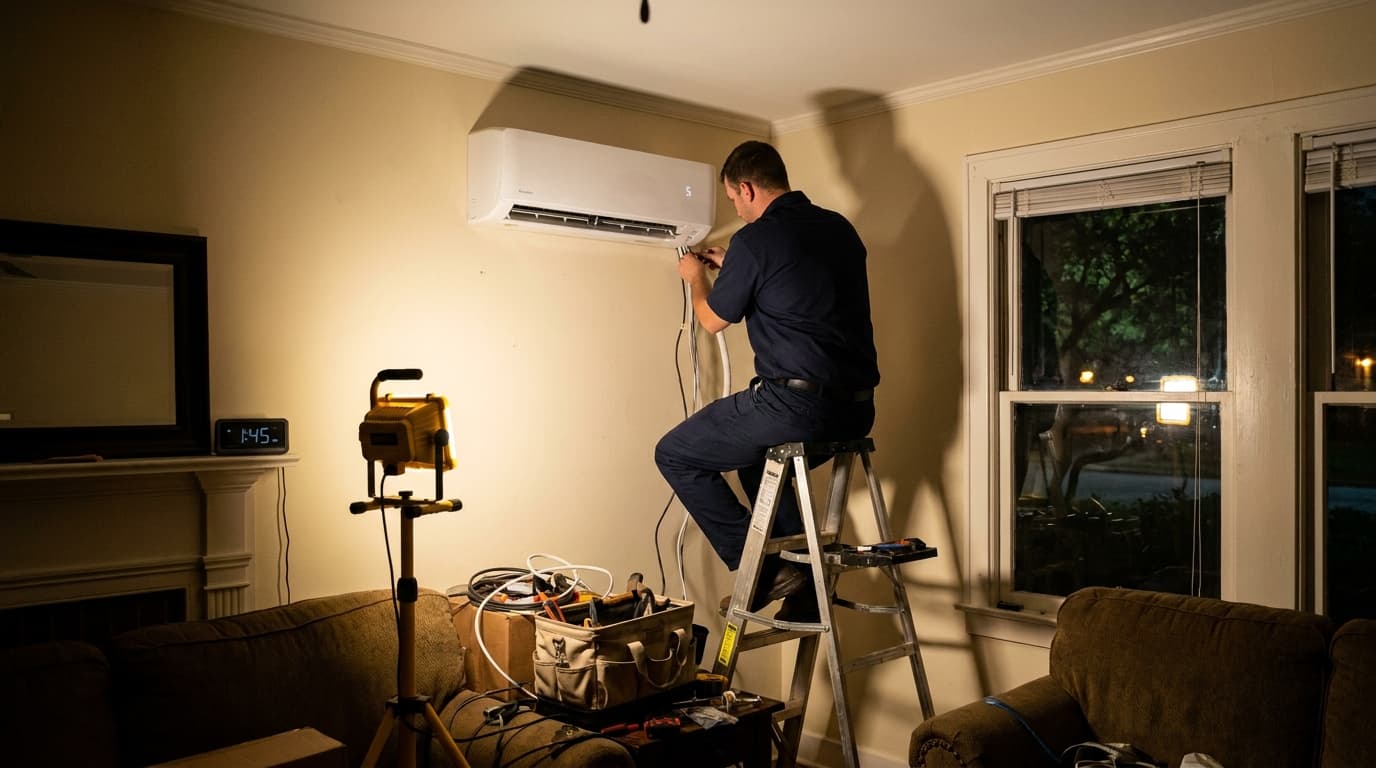
BLUF: Mitsubishi M-Series is the default for most Alabama installs. Fujitsu Halcyon wins for quiet bedroom installs. Daikin Quaternity wins for humidity-critical applications. LG Art Cool wins on budget. The three top brands differ by specialty — not by global ranking.
The Scoring Framework
Brand comparisons in HVAC are usually useless because they score on the wrong dimensions. Consumer review sites rank by online star ratings from homeowners who cannot distinguish installer competence from equipment quality. Specification-sheet comparisons rank by peak SEER2 or minimum decibel numbers that vary marginally across brands. Neither approach matches how an experienced technician actually picks equipment for a specific install.
Here is the scoring framework we actually use across Leeds, Moody, Pinson, Clay, and Springville:
- Parts availability in the Alabama network. When the ECM blower motor fails in year 9, how fast can we get a replacement from an Alabama distributor?
- Install specialty fit. Bedroom vs garage vs historic home vs multi-zone require different priorities.
- Service literature quality. Manufacturer fault-code documentation and remote diagnostic support matter during the 15 to 20 year service life.
- Warranty claim velocity. How fast does the manufacturer process replacement parts under warranty?
- Contractor familiarity. Birmingham-area contractors who install ductless regularly have installed more Mitsubishi than any other brand by volume. Familiarity reduces install defects.
Mitsubishi Electric — The Default
Mitsubishi is the most widely installed ductless brand in the Alabama market. The M-Series wall-mount is the category standard. MXZ multi-zone condensers support 2 to 8 zones. The Hyper-Heat H2i product line delivers full heating capacity down to minus 13°F for cold-climate applications. Mitsubishi's Kumo Cloud thermostat ecosystem handles multi-zone control from a single app.
Strengths:
- Strongest Alabama parts network — Birmingham-area distributors stock Mitsubishi M-Series parts at higher inventory levels than any other ductless brand.
- Strongest contractor familiarity — more Alabama HVAC contractors have installed Mitsubishi M-Series than any other ductless line.
- Best warranty claim support through the Mitsubishi dealer network.
- Hyper-Heat H2i is the gold standard for cold-climate heat pump performance if needed.
- Kumo Cloud is the best multi-zone app control among the leading brands.
Weaknesses:
- Indoor head decibel ratings slightly higher than Fujitsu Halcyon (22 to 24 dB vs 20 to 22 dB at low fan).
- Premium pricing — 5 to 10 percent above Daikin and 15 to 25 percent above LG on equivalent capacity.
- No dedicated dehumidification mode equivalent to Daikin Quaternity.
Best for: garages, workshops, multi-zone residential, historic homes, bonus rooms, and any install where parts availability matters for a 15+ year service life. Reference: Mitsubishi Comfort.
Fujitsu (Halcyon) — The Quiet Choice
Fujitsu General's Halcyon line is the quietest ductless product available in the U.S. residential market. Halcyon wall-mount indoor units measure 20 to 22 decibels at low fan speed — below the threshold where most homeowners perceive indoor unit noise at all. Halcyon multi-zone systems handle up to 8 indoor heads from a single outdoor condenser. Halcyon Slim Ducted is the concealed above-ceiling option when homeowners do not want a visible wall head.
Strengths:
- Quietest indoor unit operation in the category.
- Excellent multi-zone performance — condensers maintain full capacity even when only one of multiple zones is calling.
- Halcyon Slim Ducted offers a concealed-install option with ductless efficiency.
- Competitive warranty terms (10 year compressor, 5 year parts on most residential models).
Weaknesses:
- Parts network in Alabama is smaller than Mitsubishi — not bad, but not as deep as M-Series stocking levels.
- Fewer Birmingham-area contractors install Halcyon primary, which means install quality varies more across the contractor pool.
- No dedicated cold-climate model line equivalent to Mitsubishi H2i (though standard Halcyon handles Alabama winter without issue).
Best for: bedrooms, nurseries, home offices, libraries — any install where indoor unit noise matters more than parts stocking depth. Reference: Fujitsu General USA.
Daikin — The Humidity Specialist
Daikin is the global volume leader in ductless and a major residential presence in the U.S. market. Daikin Aurora handles cold-climate heating down to minus 13°F. Daikin Quaternity is the only ductless single-zone system with a dedicated dehumidification mode. Daikin Emura is the designer indoor unit with distinctive architectural profiles. MXS multi-zone condensers support up to 5 zones from a single outdoor unit.
Strengths:
- Quaternity dehumidification mode is a meaningful Alabama summer advantage — removes humidity without dropping temperature.
- Aurora cold-climate heating is engineered for minus-13°F operation — overkill for Birmingham, meaningful for higher-elevation installs.
- Competitive pricing — typically 5 to 10 percent below Mitsubishi for equivalent capacity.
- Strong inverter technology recognized as engineering benchmark in the ductless category.
Weaknesses:
- Parts network in Alabama is similar to Fujitsu — decent but not as deep as Mitsubishi.
- Fewer Birmingham-area contractors install Daikin as a primary brand.
- Warranty claim processing can run longer than Mitsubishi in some documented cases.
Best for: homes with extreme humidity problems, Leeds properties near the Coosa River corridor, Pinson crawlspace-vapor homes, and any install where dehumidification matters more than parts-network depth. Reference: Daikin Comfort.
Honorable Mention — LG Art Cool
LG is the budget choice. Art Cool Mirror has the best-looking indoor head in the category for homeowners who prioritize visual design. LG multi-zone systems deliver competitive cooling at 15 to 25 percent below Mitsubishi pricing. For homeowners who cannot justify the premium on the big three, LG is a reasonable fallback. Our primary caution: LG parts availability in Alabama is thinner than Mitsubishi or Daikin, which extends repair timelines when components fail in year 8 to 12.
Head-to-Head by Install Type
This is how a licensed technician picks the right brand for a specific install:
- Garage or workshop single-zone: Mitsubishi M-Series. Parts availability and contractor familiarity drive this. LG as budget fallback.
- Bedroom or home office (noise-sensitive): Fujitsu Halcyon. 2 to 4 dB quieter matters in a bedroom at night.
- Historic home multi-zone replacement: Mitsubishi M-Series with MXZ multi-zone condenser. Backup: Daikin.
- Humidity-heavy Leeds / Coosa River property: Daikin Quaternity if the budget supports it. Mitsubishi + separate dehumidifier as alternative.
- Bonus room over garage: Mitsubishi M-Series or Fujitsu Halcyon equal choice.
- Budget-constrained whole-home multi-zone: LG Multi-Zone with Art Cool indoor heads.
- Higher-elevation Clay / Springville with heat-heavy strategy: Mitsubishi H2i or Daikin Aurora for cold-climate premium.
What the AHRI Certificate Tells You
Regardless of brand, always verify the AHRI certificate for the specific indoor-outdoor pairing being installed. SEER2 and HSPF2 ratings listed on marketing literature apply only when the equipment is matched per the AHRI directory. Mismatched pairings get lower real-world efficiency and may not qualify for utility rebates or manufacturer warranty coverage. The AHRI Certification Directory is public and free. Any contractor proposing a system should be able to pull the AHRI certificate for the pairing on demand.
Bottom Line
For most Alabama ductless installs, Mitsubishi M-Series is the right default. Fujitsu Halcyon is right when noise matters. Daikin Quaternity is right when humidity matters. LG is right when budget matters. The three leaders are separated by specialty, not by global ranking — and an Alabama installer who pretends otherwise is selling a brand rather than selecting the right equipment for your specific install.
Alabama Ductless Mini-Split Buyer's Guide
A practical 8-page PDF covering sizing, single vs multi-zone, brand comparison, install cost factors, humidity control, efficiency, and the questions to ask a contractor before signing. No sales pitch, no email list — one PDF, one email.