Diagnostic
AC Running But Not Cooling — Eight Causes
The temperature split is the first reading. From there: filter, frozen coil, dirty condenser, capacitor, refrigerant, ductwork. The cheap-to-expensive order a tech runs.
Read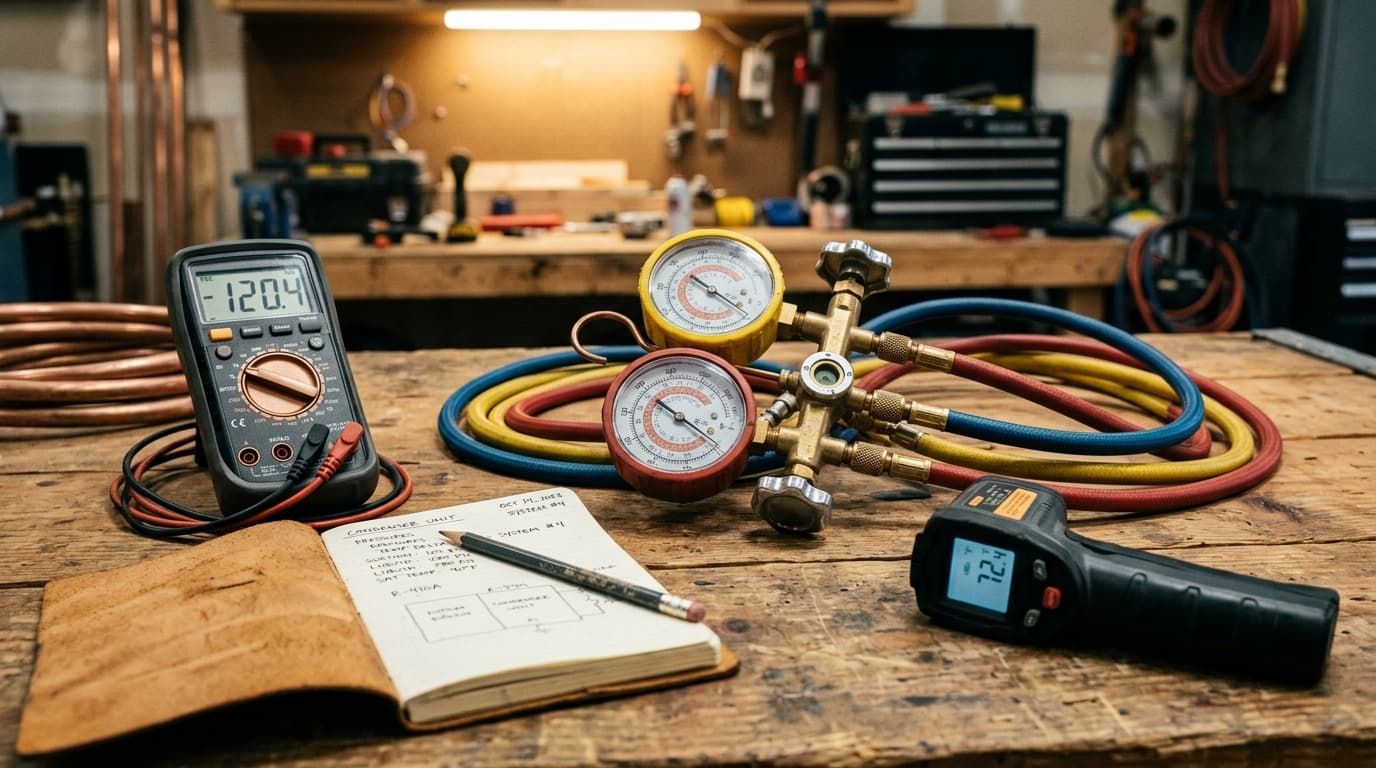
The cheap-to-expensive diagnostic order.
Twelve dispatches written by a licensed east-corridor technician — capacitor failures, frozen coils, refrigerant leaks, breaker trips, and the diagnostic order you should run before the truck arrives. Every diagnostic field guide we publish.
This is the diagnostic field hub for Emergency AC Repair Service — every failure-mode and field-guide blog post we publish, organized by the order a Birmingham tech actually walks through a service call.
The articles below are not generic Google-search content. They are the cheap-to-expensive checklist a licensed east-corridor technician runs on a real residential AC system, with the homeowner-safe checks called out separately from the licensed-tech work.
If your AC is acting up right now and you want to understand what the tech will do, start with the top of the components list and work down. If you just want the truck dispatched, the service link is in the grid below.
Birmingham's east-corridor service area carries a distinct failure-mode profile compared to the national HVAC literature. Capacitors fail earlier here because summer ambient temperatures push outdoor units harder. Contactors weld closed more often because of regional insect activity (ants love the contactor housing). Frozen coils cluster in early summer because filter changes lag behind the pollen bloom.
A tech who has run Alabama summer routes for a decade knows which failure mode is most likely on a given service call before the truck stops moving — based on the home age, the equipment age, the day of the year, and what the homeowner said on the dispatch call. The field guides below codify that pattern recognition.
When a guide says "check this first," it is because that check resolves roughly half of east-corridor AC failures. When it says "stop and call," it is because the next step requires gauges, EPA certification, or both.
Twelve resources organized as a single diagnostic walk-through. Read in any order; or follow them top-to-bottom for the full east-corridor field-tech workflow.
The temperature split is the first reading. From there: filter, frozen coil, dirty condenser, capacitor, refrigerant, ductwork. The cheap-to-expensive order a tech runs.
ReadIndoor blower runs, outdoor unit silent. The diagnostic chain — breaker, thermostat, transformer fuse, capacitor, contactor, internal overload, start components.
ReadThe shop-vac procedure techs use. Vinegar flush schedule. Bleach vs vinegar tradeoffs. Why Alabama humidity makes this monthly maintenance.
ReadClogged drain, frozen coil, rusted pan, dead pump, dirty filter, broken float switch. Identify the cause before water damage spreads.
ReadSix different parts can hum. Each sound maps to a different failure mode. When to cut power immediately and when to wait for the truck.
ReadA tripping breaker is a real fault, not a glitch. Every cause in the order a tech checks them — and when to stop resetting and pick up the phone.
ReadPower came back but the AC stayed silent. Surge damage, contactor lockout, transformer failure — the safe reset sequence to try first.
ReadThe coil operates below 32°F. When airflow or refrigerant drops, it turns into an ice block. Every reason it happens, and the cheap-vs-call-a-tech fix path.
ReadYour AC runs all day and the house stays clammy at 75°F. Latent heat vs sensible heat — and it is fixable. A technician's explanation.
ReadWhen the tech is two hours out and the thermostat reads 88, what do you actually do for the next two hours? The Birmingham survival playbook.
ReadThe honest line between homeowner-safe checks and licensed-technician territory. Thermostat, filter, breaker, then phone — every time.
ReadThe diagnostic-first repair service. Capacitor microfarad reading, refrigerant pressures by superheat and subcooling, written estimate before any parts go in.
ReadThree readings, before opening anything. (1) Thermostat — does the call for cool reach the equipment? (2) Filter — is the return airflow restricted? (3) Temperature split — supply air vs return air across the evaporator. A healthy split is 18 to 22 degrees. A split below 12 means the system is not removing heat from the air; a split above 22 usually means restricted airflow. Those three readings narrow the problem to a handful of components before any panel comes off.
You do not. Capacitors store lethal voltage even after the system is powered down. A failed capacitor is the most common AC repair in Birmingham — and the most common DIY electrocution path. A licensed technician shorts the capacitor with an insulated screwdriver, checks the microfarad rating with a meter against the data plate, and replaces it for under $50 in parts. The labor is the safety expertise, not the part swap.
Two root causes. (1) Airflow restriction — clogged filter, blocked return, dirty evaporator coil, undersized ductwork, failed blower motor. (2) Refrigerant problem — low charge from a leak, or a TXV/metering device failure. The evaporator coil temperature drops below freezing, water vapor in the airstream freezes onto the coil, and what was supposed to be cool air turns into an ice block. Shut the system off, let it thaw for 4 to 6 hours, change the filter, and watch for repeat behavior.
The temperature split is the difference between supply-air temperature and return-air temperature across the evaporator coil. Healthy: 18 to 22 degrees. Below 12: the system is barely cooling — likely low refrigerant, undersized system, or system failure. Above 22: airflow is restricted — clogged filter, dirty coil, undersized ductwork. A consumer-grade infrared thermometer can read this in 30 seconds and gives you a real number to share when you call dispatch.
Indirect signs only — direct refrigerant diagnosis requires gauges. Suspect a leak when: (a) the system was fine last summer and is weak this summer, (b) ice forms on the larger of the two outdoor refrigerant lines, (c) you hear hissing near the indoor coil or outdoor unit, or (d) the evaporator coil freezes repeatedly after the filter has been replaced. EPA Section 608 federal law restricts refrigerant work to certified technicians. A leak search costs a fraction of a recharge that gets vented in three months.
Cautiously. After a storm or outage, wait 5 to 10 minutes before turning the thermostat back to COOL — that gives the compressor crankcase heater time to clear refrigerant from the oil and prevents a hard-start failure. If the system stays silent or trips a breaker immediately, do not keep resetting. Surge damage to the control board, transformer, contactor, or capacitor is common after Birmingham summer storms and needs a tech.
The contactor is the heavy-duty relay that turns the outdoor unit on and off when the thermostat calls for cooling. It is rated for thousands of cycles, but Alabama insects (ants, especially) crawl inside, get electrocuted, and weld the contact points together. When the contactor welds closed, the AC runs continuously regardless of the thermostat. When it welds open, the AC will not start at all. A $40 part with 30 minutes of labor — but it needs the right replacement for the system's amp draw and voltage.
Dial now and a technician picks up — or leave your name and we'll call back the moment we're off the current job.