What to Do When Your AC Stops Working in Birmingham AL
Your AC stopped working in Birmingham AL — now what? Step-by-step emergency guide covering what to check first, when to call a licensed pro, and how to stay cool safely.
Your air conditioner just stopped working. The house is getting warmer by the minute. Maybe you hear it running but no cold air comes out, or maybe it will not turn on at all. Either way, the temperature in your Birmingham home is climbing, and you need to figure out your next move quickly and calmly.
Quick Answer
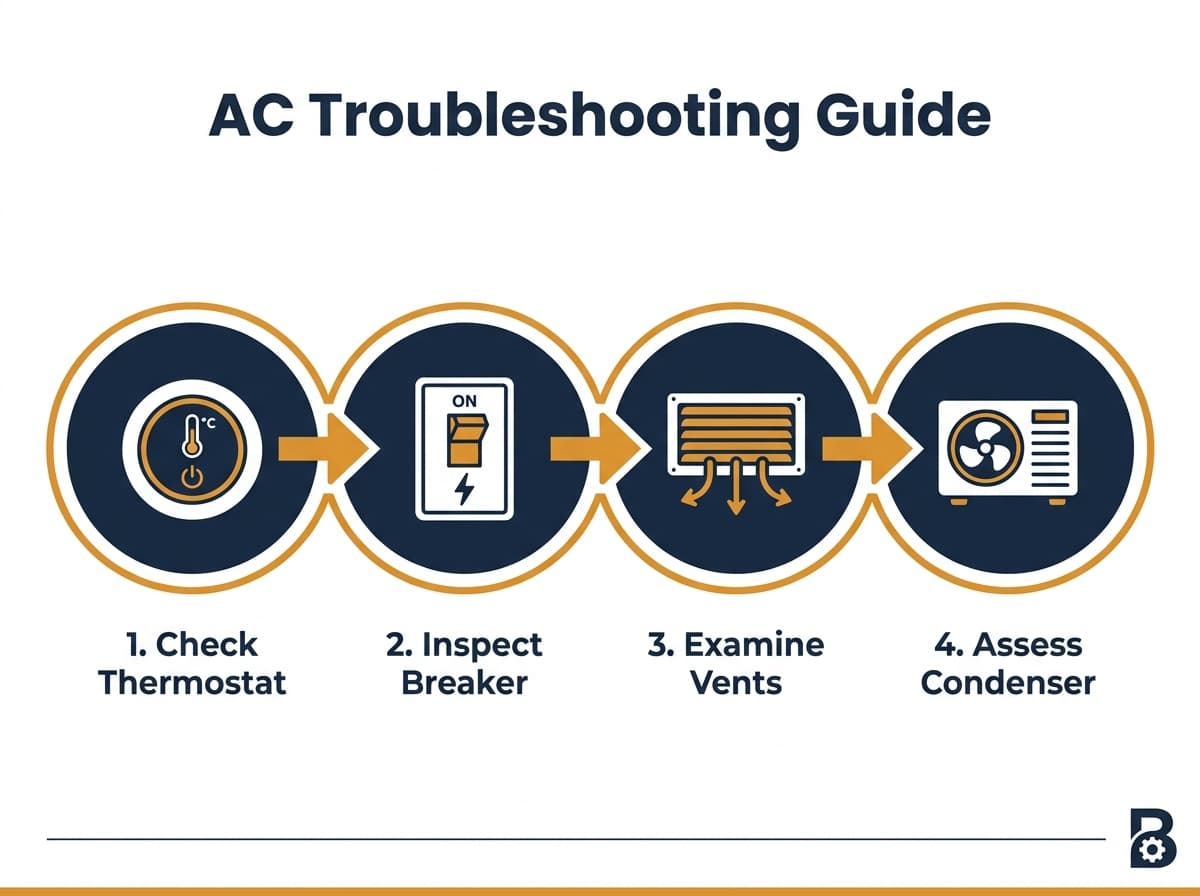
When your AC stops working: 1) Check the thermostat settings, 2) Replace the air filter if dirty, 3) Check the breaker panel, 4) Inspect the outdoor unit. If none of these fix it, call a licensed HVAC technician. While waiting, close blinds, use fans, and stay hydrated.
Take a deep breath. This comprehensive guide walks you through everything you need to do, step by step, when your AC fails. Some of these steps might actually fix the problem and save you a service call entirely. Others will help you stay comfortable and safe while waiting for a technician. And all of them will help you make smart decisions during a stressful situation. We have written this guide specifically for Birmingham-area homeowners because our climate creates unique urgency when cooling systems fail.
Step 1: Check Your Thermostat First
Before you do anything else, check your thermostat. This sounds obvious, but we estimate that 10 to 15 percent of our emergency calls turn out to be thermostat-related issues that homeowners could have resolved themselves. A few minutes of thermostat troubleshooting can potentially save you time and money.
Start with the basics:
- Make sure your thermostat is set to COOL mode, not heat or off
- Verify that the set temperature is at least 3-5 degrees below the current room temperature
- Check that the fan setting is on AUTO rather than ON
- For smart thermostats, check WiFi connectivity and battery backup
If you have a smart thermostat like a Nest, Ecobee, or Honeywell Home, check for several digital issues that can mimic mechanical failures. WiFi connectivity problems can cause the thermostat to go into a default mode. Software updates may have changed your programming or schedule settings. The battery backup, if your model uses one, may have died, causing the thermostat to lose its connection to the HVAC system.
Try rebooting your thermostat. For smart thermostats, remove the unit from the wall plate for 30 seconds, then reattach it. This forces a restart that clears temporary software issues. For traditional thermostats, turn the system off at the thermostat, wait 30 seconds, and turn it back on. For battery-powered thermostats, replace the batteries with fresh ones.
Key Takeaway
About 10-15% of emergency AC calls turn out to be thermostat issues the homeowner could fix themselves. Always check settings, batteries, and breakers before calling for service.
Step 2: Check Your Air Filter
A severely clogged air filter is one of the most common causes of AC system failure, and it is the easiest thing for a homeowner to check and fix. When the filter becomes so dirty that it blocks airflow, several bad things happen simultaneously:
- The evaporator coil can freeze solid
- The system can overheat and shut down on a safety switch
- The blower motor can burn out from working against excessive resistance
Locate your air filter. In most Birmingham homes, the filter is in the return air grille on a wall or ceiling, or at the air handler in a utility closet, attic, or garage. Some homes have filters in both locations. Pull the filter out and examine it carefully. If you cannot see light through it when held up to a light source, it needs to be replaced immediately.
If your filter is extremely dirty, replace it with a new one and then wait two to three hours before restarting your system. This waiting period is important. If the evaporator coil froze due to restricted airflow, it needs time to thaw completely before the system can operate normally. Running the system with a frozen coil forces the compressor to work against abnormal pressures and can cause serious, expensive damage.
10-15%
of emergency AC calls in Birmingham are caused by thermostat issues or dirty filters that homeowners can fix themselves
Step 3: Check the Breaker Panel
Your HVAC system typically uses two separate breakers: one for the indoor unit (air handler or furnace with evaporator coil) and one for the outdoor unit (condensing unit). If either breaker has tripped, the system will not function correctly. Tripped breakers are a common occurrence during Birmingham summers when electrical demand peaks across the entire neighborhood.
Find your electrical panel and locate the HVAC breakers. They are usually labeled, but if they are not, look for larger breakers (typically 20 to 40 amps for HVAC versus 15 amps for general household circuits). The HVAC breakers may be double-width breakers that take up two slots in the panel.
If a breaker is in the tripped position (halfway between on and off, or showing a red indicator), flip it fully to the off position, wait 10 seconds, then flip it firmly to the on position. Then wait five minutes before checking whether the system starts up. HVAC systems have built-in time delays that prevent immediate restart after a power interruption.
Key Takeaway
If the breaker trips again within a few minutes, do not keep resetting it. A breaker that repeatedly trips is protecting your home from an electrical fault in the HVAC system. This situation requires a professional technician.
Also check for a disconnect switch near your outdoor unit. Most installations have a weatherproof disconnect box mounted on the wall near the condenser, usually within sight of the unit. This switch can sometimes be accidentally turned off during yard work or landscaping, or the fuse inside it can blow during a power surge.
AC acting up? Do not wait until it dies completely.
Call (205) 206-5252Step 4: Look at Your Outdoor Unit
Go outside and look at your outdoor condensing unit. This is the large metal box, usually located on a concrete pad at the side or back of your home. Several observable conditions can tell you a lot about what is happening with your system, even if you are not a trained technician.
| What You See | What It Likely Means | What To Do |
|---|---|---|
| Fan not spinning, unit silent | Failed capacitor, contactor, or power issue | Check breakers, then call for service |
| Fan wobbling, trying to start | Bad capacitor — very common in Birmingham summers | Call for service, usually a quick repair |
| Fan running but no compressor hum | Compressor failure or thermal protection tripped | Turn system off for 30 min, try again |
| Buzzing but nothing starts | Capacitor failure | Do not keep trying, call a technician |
| Heavy ice on lines | Refrigerant leak or severe airflow restriction | Turn off system, let it thaw 2-3 hours |
Check for obvious obstructions. Ensure that landscaping, debris, leaves, and other materials are not blocking airflow around the unit. The condenser needs at least two feet of clearance on all sides to function properly. In Birmingham, tall grass, kudzu, and landscaping can quickly encroach on outdoor units during the growing season. If the unit is heavily obstructed, carefully clear the area and see if the system begins functioning better.
Look at the refrigerant lines, the two copper pipes running from the outdoor unit into your home. The larger line should be insulated and may feel cold and sweaty during normal operation. If both lines are warm or the insulated line has ice forming on it, these are diagnostic clues that will help your technician identify the issue more quickly when they arrive.
Step 5: Stay Cool While Waiting for Repair
If the troubleshooting steps above did not resolve the issue, it is time to call a professional. But while you wait for the technician to arrive, there are effective strategies to keep your family comfortable and prevent your home from becoming dangerously hot. In Birmingham's summer climate, this is not just about comfort. It is about safety.
- Close all blinds and curtains, especially on south and west-facing windows
- Use ceiling fans set counterclockwise and portable fans for air movement
- Open windows strategically if outdoor temperature is lower than indoor temperature
- Avoid heat-generating appliances — no oven, stove, or clothes dryer
- Stay hydrated — drink water regularly even if you do not feel thirsty
- Move to the lowest level of your home where it is naturally cooler
If you have elderly family members, infants, or people with medical conditions in the home and the indoor temperature exceeds 85 degrees, consider temporarily relocating to a cooled environment. This might be a friend or family member's home, a hotel, a public library, or a community cooling center. Heat-related illness is a genuine medical emergency that is more common than most people realize, particularly among vulnerable populations.
Step 6: Choose the Right Repair Service
Not all HVAC companies are created equal, and choosing the right one during an emergency can save you significant money and frustration. Here is what to evaluate when selecting an emergency AC repair service in the Birmingham area.
- Verify Alabama mechanical contractor licensing
- Ask for upfront, written pricing before any work begins
- Check response time commitments for your area
- Ask about after-hours and weekend surcharges
- Read recent Google and Yelp reviews — look at volume and recency, not just star ratings
24/7
Emergency AC repair should be available around the clock — your system does not check the calendar before it fails
Step 7: Understand Your Repair Options
When the technician arrives and diagnoses the problem, you will be presented with repair options. Understanding these options helps you make the best decision for your situation and budget.
A good technician will explain the problem in plain language you can understand, describe the recommended repair and why it will fix the issue, provide a written estimate with the total cost before beginning work, explain any warranty coverage on the repair, and give an honest assessment of whether repair or replacement makes more economic sense given your system's age and overall condition.
| Repair Type | When to Repair | When to Consider Replacement |
|---|---|---|
| Capacitor or contactor | Almost always repair — normal wear items | Only if multiple electrical failures simultaneously |
| Fan motor | Repair if system under 12 years | Consider if system is 15+ years old |
| Refrigerant leak | Repair if using R-410A | Strongly consider replacement if using R-22 |
| Compressor | Repair if system under 8 years | Usually replace if system over 12 years |
Never feel pressured to make an immediate decision on expensive repairs. A reputable technician will give you time to think, encourage you to get a second opinion if you want one, and will not use high-pressure sales tactics or artificial urgency. If a technician tries to pressure you into an immediate decision on a major repair or replacement, consider that a significant red flag about the company.
Step 8: Prevent Future Emergencies
Once your AC is running again, take proactive steps to prevent the next emergency. Prevention is always less expensive, less stressful, and less disruptive than emergency repair, and it is particularly important in Birmingham's demanding climate.
- Schedule bi-annual professional maintenance — spring and fall tune-ups
- Change the air filter monthly during summer (April through October)
- Keep the outdoor unit area clear of debris and vegetation
- Do not close more than 20 percent of your supply vents
- Maintain a consistent thermostat temperature
- Schedule service promptly if you notice warning signs
AC acting up? Do not wait until it dies completely.
Call (205) 206-5252When to Call Emergency AC Repair Service
If you are a Birmingham homeowner dealing with an AC failure right now, call us at (205) 206-5252. Our licensed technicians are available 24/7 throughout the Birmingham metro area including Hoover, Vestavia Hills, Homewood, Mountain Brook, Trussville, Pelham, Alabaster, and Gardendale. Every repair begins with a written estimate before work starts.
Do not suffer through the heat. One call and help is on the way.
Frequently Asked Questions
What should I do first when my AC stops working in Birmingham?
Emergency AC Repair Service recommends checking your thermostat settings first, then inspecting the air filter, and checking the breaker panel. If these steps do not restore cooling in your Birmingham, Alabama home, call Emergency AC Repair Service at (205) 206-5252 for 24/7 emergency service.
How do I stay cool while waiting for AC repair in Birmingham?
Emergency AC Repair Service advises Birmingham, Alabama homeowners to close all blinds and curtains especially on south and west-facing windows, use ceiling and portable fans, avoid heat-generating appliances, stay hydrated, and consider relocating vulnerable family members if indoor temperatures exceed 85 degrees.
Free Birmingham HVAC Homeowner Checklist
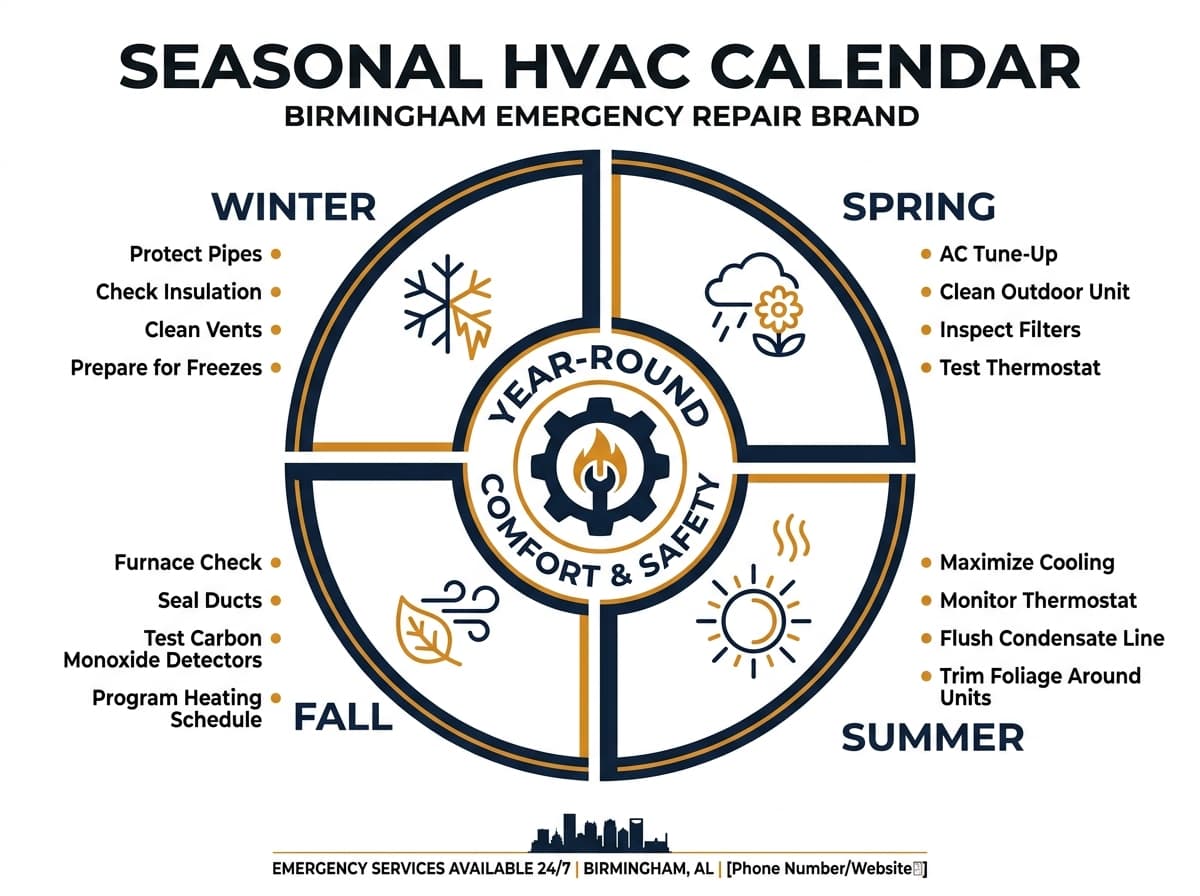
Download our seasonal maintenance checklist designed for Birmingham's climate. Covers spring prep, summer survival, fall tune-up, and winter protection — the same checklist our technicians use on service calls.
Call (205) 206-5252 to RequestSources & Citations
- U.S. Environmental Protection Agency — Indoor Air Quality
- U.S. Department of Energy — Heating & Cooling
- ASHRAE — American Society of Heating, Refrigerating and Air-Conditioning Engineers
- ENERGY STAR — Heating & Cooling Equipment
- Alabama General Contractor Licensing Board
- U.S. EPA — Section 608 Technician Certification
Emergency AC Repair Service Editorial Team
Licensed HVAC Professionals • Birmingham, Alabama
Our content is written and reviewed by an Alabama-licensed, EPA Section 608–certified editorial team focused on residential AC and cooling systems. This piece was reviewed against the day-to-day residential cooling work our technicians do across Birmingham’s east corridor — real diagnostic calls, manufacturer training, and current Alabama HVAC code rather than generic advice.
Related Resources
Need Emergency AC Repair in Birmingham?
Available 24/7 across the Birmingham metro area. Licensed and insured.
(205) 206-5252Read Next