Outdoor Unit Dead in 95° Heat? Likely the Fan Motor.
Emergency outdoor condenser fan motor repair across the east corridor — Leeds, Trussville, Moody, Pinson, Clay, Springville. Dead fan motors, blown dual-run capacitors, bent blades, seized bearings. Our trucks stock the 1/4, 1/3, and 1/2 HP PSC motors that fit most Birmingham-area residential systems. Same-truck repair on most calls. Live answer 24 hours a day. Written estimate before any work begins.
Call (205) 206-5252 NowEast Birmingham HVAC Tech. AL HVAC licensed, bonded, insured. EPA Section 608 Universal certified.
Same-Truck Repair
1/4, 1/3, 1/2 HP in Stock
Capacitor Replaced Too
AL Licensed Tech
Symptoms of Outdoor Fan Motor Failure
When the outdoor unit fan stops spinning, the system is already in trouble. Recognizing the symptom early — and shutting the system off — is the difference between a $500 motor replacement and a $2500 compressor replacement.
Fan Not Spinning, Compressor Humming
Classic dead fan motor signature. Compressor tries to start, the head pressure climbs because there is no airflow over the condenser coil, and the system locks out on high-pressure or overcurrent. Shut it off — running like this can kill the compressor.
Fan Spins Slowly Then Stops
Dual-run capacitor failure. The capacitor energizes both the compressor and the fan motor. As it degrades, the fan motor starts weakly and stalls. Often caught and fixed before motor damage occurs.
Fan Makes Grinding or Squealing Noise
Failing motor bearings. The grinding gets louder over weeks and then the motor seizes. Replacement during a planned visit is cheaper than emergency replacement after the seized motor takes out the capacitor too.
Fan Blade Visibly Bent or Hitting Shroud
Impact damage from a fallen branch, hail, or debris. A bent blade vibrates, wears motor bearings, and can crack the hub. Blade replacement is one of the cheaper repairs we do.
Outdoor Unit Will Not Start at All
Could be the contactor, the breaker, the disconnect, or the fan motor. Diagnostic walks the electrical path from the breaker through the disconnect, contactor coil, and motor windings.
Burning Smell from Outdoor Unit
Motor windings failing under load. The smell is varnish breakdown from overheated insulation. Shut the system off at the breaker. Continued operation risks fire or compressor damage.
Why Birmingham Heat Kills Fan Motors
The outdoor condenser fan motor on a Birmingham residential AC runs in the worst possible operating environment. Direct exposure to 95-100 °F ambient air, full sun on the cabinet roof, and a duty cycle that runs the motor 8-12 hours a day from June through September. The bearings, windings, and capacitor all degrade faster here than in milder climates.
Most outdoor fan motors are permanent split capacitor (PSC) design. The dual-run capacitor energizes both the compressor and the fan motor through their respective auxiliary windings. When the capacitor weakens — usually after 7-10 years in the Birmingham climate — the fan motor draws excess current trying to start. Motor windings overheat, insulation breaks down, and eventually the motor fails open or short.
Newer high-efficiency systems use electronically commutated motors (ECM) instead of PSC. ECMs are smaller, quieter, more efficient, and last longer — but when they fail, the motor and its integrated control module replace together, and the part is more expensive. We carry both PSC and ECM replacements on the truck for the common system sizes.
What the Diagnostic Visit Looks Like
- Power off at disconnect. Before touching anything we kill power at the outdoor disconnect and discharge the capacitor with a resistor. Capacitors hold lethal voltage even with the system off.
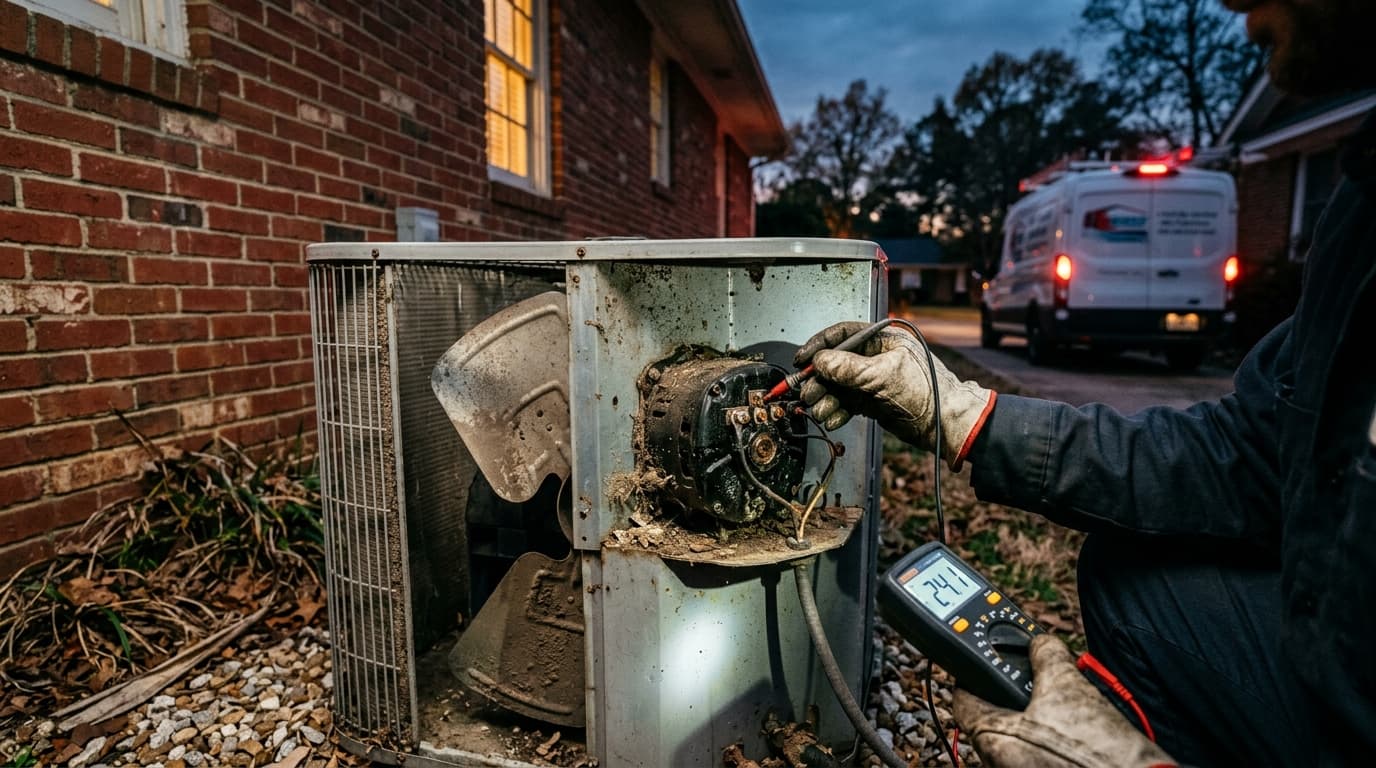
- Visual inspection of the motor and blade. Burned smell, melted wiring insulation, bent blade, foreign debris in the fan, or oil residue from leaking motor bearings.
- Capacitor measurement. Microfarad reading on a calibrated capacitance meter. A capacitor more than 6% below nameplate gets replaced — the most common single fix on outdoor fan problems.
- Motor winding resistance check. Ohmmeter across each winding pair. Open winding, shorted winding, or grounded winding all point to motor replacement.
- Contactor inspection. Pitted contacts on the compressor contactor cause voltage drop that strains the motor. Replaced if pitted.
- Bearing check. With power off, spin the fan blade by hand. Should spin freely and stop smoothly. Grinding, dragging, or play indicates failed bearings — motor replacement.
- Run amperage check after repair. With new motor or capacitor installed, measure motor running amps against nameplate full-load amps. Verifies the repair is complete.
Why We Always Quote the Capacitor Too
A failed fan motor almost always took out the capacitor with it, or was killed by the capacitor failing first. We do not replace a motor without also replacing or verifying the capacitor — it is a $40 part that prevents a $400 callback in two months. The honest version of this conversation is: if you only replace the cheaper of the two parts, the other one will fail soon and you will pay another service call. We bundle them.
What to Do Before We Arrive
- Turn the thermostat to off. Stop sending cooling calls to a system that cannot respond properly. Continued operation can damage the compressor.
- Open the outdoor disconnect if you know how. Kills power to the outdoor unit. If you are not sure where it is or how to open it safely, leave it alone — turning off the thermostat is sufficient.
- Note the system age and brand. Photo of the data plate on the outdoor unit helps us pre-stage the right motor.
- Clear around the outdoor unit. Move bikes, trash cans, fence panels, or vegetation that blocks access. Saves diagnostic time.
- Do not pour water on the unit to cool it. Water on a hot motor can fracture the windings or cause electrical shorts when power is restored.
East-Corridor Coverage
We dispatch condenser fan motor repair through Leeds, Trussville, Moody, Pinson, Clay, and Springville.
Related pages on this site: general AC repair, 24/7 emergency AC dispatch, and preventive maintenance (where most capacitor and fan motor issues are caught before they become emergencies). For diagnostic walkthroughs see our heat-wave AC failure guide and AC tripping breaker causes.
Condenser Fan Motor FAQ
Why does a condenser fan motor failure damage the compressor if I keep running it?
The outdoor coil rejects heat from the refrigerant gas leaving the compressor. The condenser fan motor moves ambient air across that coil to pull the heat out. When the fan stops, the coil cannot reject heat, and head pressure inside the compressor climbs rapidly — sometimes within 90 seconds. The compressor either trips its internal overload (recoverable), trips the high-pressure switch (recoverable), or fails outright (not recoverable, $1500-2500 replacement). Shut the system off at the thermostat the moment you notice the fan is not running.
Can I replace the fan motor myself?
Mechanically the motor swap is straightforward. Electrically there are three failure points homeowners commonly miss: incorrect capacitor microfarad rating, wrong rotation direction, and wrong blade pitch. A replacement motor wired for the wrong rotation pushes air the wrong direction across the coil. A blade with the wrong pitch moves the wrong air volume. Both kill the compressor anyway. Also, refrigerant lines are right next to the motor mount — a slip with a wrench damages the line set and now you have a refrigerant leak too. Most homeowners are better off calling us for an emergency call rather than spending the same money on the wrong parts.
How long does condenser fan motor replacement take?
On a standard residential outdoor unit with the motor in stock, replacement takes 60-90 minutes including diagnostic verification, motor swap, capacitor check, and full system test. Less common motor sizes (3/4 HP and larger, ECM motors, brand-specific configurations) may require ordering and a return visit. Our trucks stock the common 1/4, 1/3, and 1/2 HP PSC motors used in most residential systems.
Is fan motor failure related to the capacitor?
Yes — closely. A weak dual-run capacitor stresses the fan motor every time the system starts. The motor draws excess current trying to overcome insufficient starting torque, the windings heat up, and over time the motor fails. Replacing a failed motor without also testing and replacing a weak capacitor sends you straight back to the same failure in a few months. We always measure the capacitor microfarad rating against nameplate during motor service.
What size motor do I need?
Motor sizing depends on the system tonnage and the OEM specification. Most 2-ton and 2.5-ton residential systems use 1/4 HP fan motors. 3-ton and 3.5-ton systems use 1/3 HP. 4-ton and 5-ton systems use 1/2 HP. The motor data plate tells us horsepower, voltage, capacitor microfarad rating, and rotation direction. We carry universal-replacement motors that match the OEM spec for the most common Birmingham-area systems.
Should I replace the motor or the whole outdoor unit?
Honest analysis: depends on age. If the system is under 10 years old and the rest of it is healthy, motor replacement is the right call — $400-600 versus $4000+ for a new outdoor unit. If the system is 15+ years old and the motor failed plus the capacitor is weak plus the coil is dirty plus the contactor is pitted, the math tips toward replacement. We diagnose the whole system and tell you which path makes financial sense, with both options written down before you decide.
Outdoor Unit Dead Right Now?
Live answer 24 hours a day. Fan motors and capacitors stocked on every truck.
(205) 206-5252