Central Air vs Mini Split: Best Choice for Birmingham AL
Central air vs mini split — which cooling system fits your Birmingham AL home? Compare costs, efficiency, humidity control, and the best use cases for Alabama climate.
If you are considering a new cooling system for your Birmingham home, or if you need to replace an aging AC unit, you have probably encountered two primary options: traditional central air conditioning and ductless mini split systems. Both technologies cool your home effectively, but they work in fundamentally different ways and each has advantages and disadvantages that are particularly relevant to Birmingham's hot, humid climate.
Quick Answer
For most Birmingham homes with existing ductwork in good condition, central air is the more cost-effective choice. Mini splits are better for homes without ductwork, room additions, converted spaces, or supplemental cooling in problem areas. The right choice depends on your home, your ductwork condition, and your cooling patterns.
This guide breaks down both systems so you can make an informed decision based on your home, your budget, and your cooling needs.
How Central Air Conditioning Works
Central air conditioning is the system most Birmingham homeowners are familiar with. It consists of an outdoor condensing unit, an indoor air handler or evaporator coil mounted on a furnace, and a network of ductwork that distributes cooled air throughout the house. A thermostat controls the system, and when the temperature rises above the set point, the compressor and blower engage to cool the entire home simultaneously.
The ductwork is the defining feature of central air. Air is pulled from the house through return ducts, passed over the cold evaporator coil to remove heat and humidity, and then pushed back into every room through supply ducts and registers. This creates a consistent temperature throughout the home because the same conditioned air is distributed to every room served by the duct system.
Central air has been the standard cooling solution in Birmingham since the widespread adoption of residential air conditioning in the 1960s and 1970s. The vast majority of homes in established Birmingham neighborhoods, from Mountain Brook and Vestavia Hills to Hoover, Homewood, Trussville, and Pelham, were built with central air ductwork integrated into the original construction.
How Ductless Mini Split Systems Work
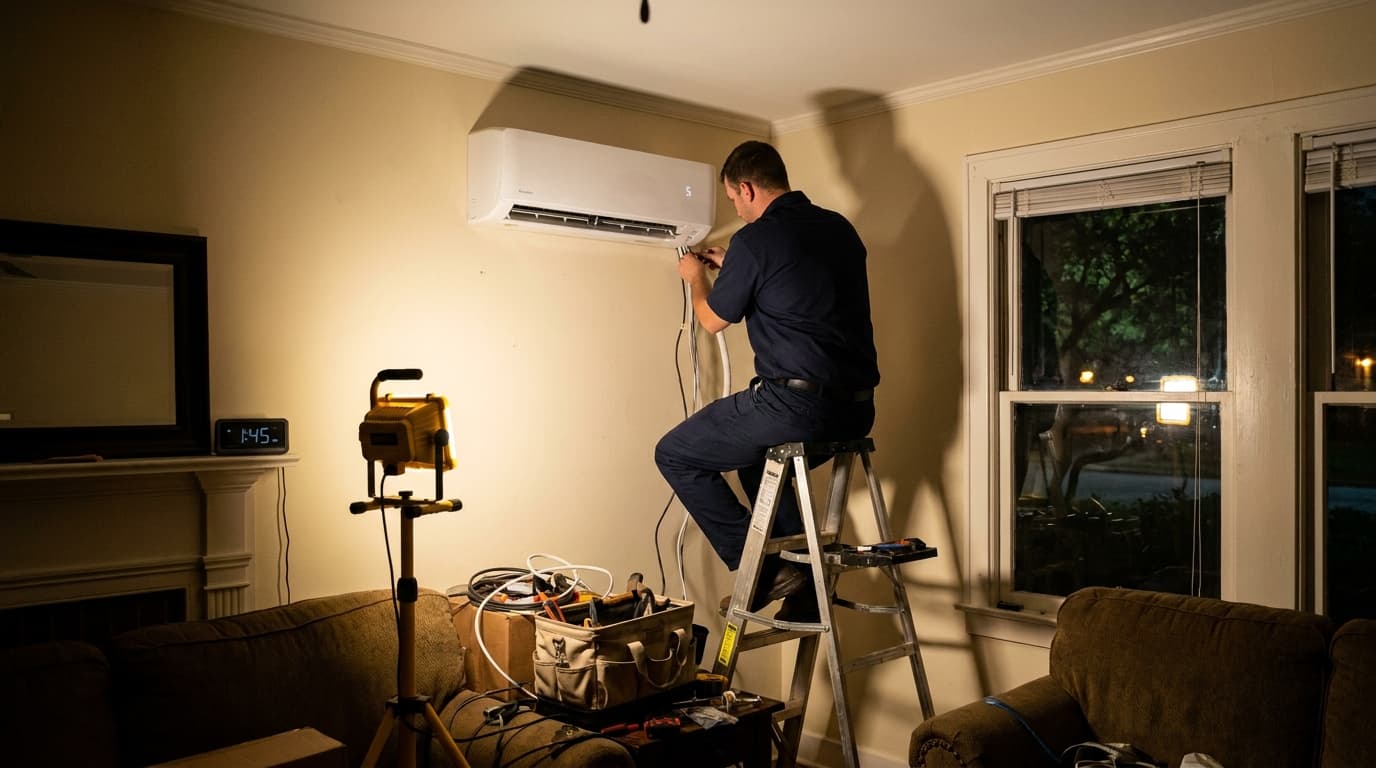
A ductless mini split system consists of an outdoor compressor unit connected to one or more indoor wall-mounted or ceiling-mounted air handlers by refrigerant lines and electrical wiring. Each indoor unit cools a specific zone or room, and each zone can be controlled independently with its own thermostat or remote control.
The key difference is the absence of ductwork. Instead of cooling air in a central location and distributing it through ducts, a mini split system delivers cooled air directly into the room where the indoor unit is mounted. This eliminates the energy losses associated with ductwork, which can be significant in Birmingham homes where ducts run through unconditioned attics that reach 140 degrees or more during summer.
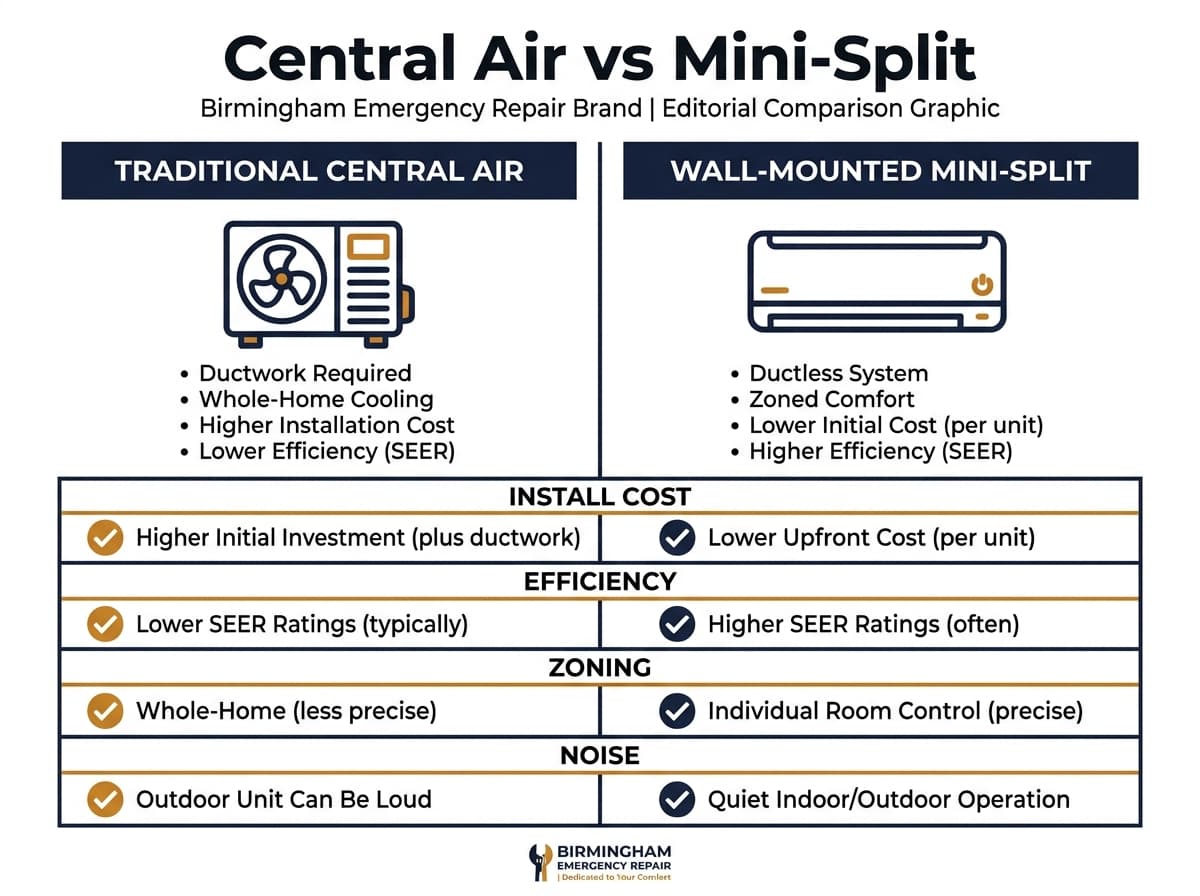
Central Air vs Mini Split: Head-to-Head Comparison
| Feature | Central Air | Mini Split |
|---|---|---|
| Best For | Whole-home cooling with existing ducts | Homes without ducts, additions, problem rooms |
| Upfront Cost (existing ducts) | Lower | Higher for same coverage |
| Upfront Cost (no ducts) | Higher (must install ductwork) | Lower |
| Energy Efficiency | Good — but 20-30% duct losses | Excellent — zero duct loss |
| Humidity Control | Excellent whole-home dehumidification | Good per-zone, less consistent whole-home |
| Appearance | Hidden registers and grilles | Wall-mounted units visible in rooms |
| Zone Control | Single thermostat for whole home | Independent control per zone |
| Maintenance | One system to maintain | Multiple indoor units to maintain |
| Cooling Capacity | Handles 3,000-4,000+ sq ft easily | Multiple units needed for large homes |
Key Takeaway
If your Birmingham home already has ductwork in good condition, replacing central air with central air is almost always the most cost-effective path. Save the mini split option for spaces that ductwork cannot practically reach.
Central Air: Advantages for Birmingham Homes
Central air conditioning offers several important advantages for Birmingham homeowners, particularly those in existing homes that already have ductwork installed.
- Whole-home cooling from a single system with consistent temperature everywhere
- Lower upfront cost for homes with existing ductwork
- Better whole-home humidity control — essential in Birmingham's 70-85% summer humidity
- Invisible installation with registers recessed into floors, walls, or ceilings
- Higher cooling capacity for large homes (3,000 to 4,000+ square feet)
20-30%
of cooled air is lost through ductwork in unconditioned attic spaces — a major factor in Birmingham energy bills
Mini Split: Advantages for Birmingham Homes
Ductless mini split systems offer their own set of advantages that make them the better choice in specific situations common to Birmingham homeowners.
- No ductwork required — ideal for older Birmingham homes in Avondale, Woodlawn, East Lake, and Southside
- Zone control allows cooling only the rooms you are using
- Zero duct losses — delivers cooled air directly into the room
- Perfect for room additions, enclosed porches, finished garages, and converted attics
- Individual temperature control for each zone
AC acting up? Do not wait until it dies completely.
Call (205) 206-5252When Central Air Is the Better Choice in Birmingham
For most Birmingham homes with existing ductwork in good condition, central air replacement is the better choice when the current system needs replacing. The math is straightforward: the ductwork is already installed, a central system provides consistent whole-home cooling and dehumidification, and the replacement cost is significantly lower than a multi-zone mini split installation that covers the same area.
Central air is also the better choice for:
- New construction where ductwork cost is included in the build
- Homes where the entire house needs cooling simultaneously
- Families with children and multiple occupants using most rooms daily
- Homes over 2,500 square feet where multiple mini split units add cost and complexity
When a Mini Split Is the Better Choice in Birmingham
Mini splits are the clear winner for specific situations that are common across the Birmingham metropolitan area.
- Older homes without existing ductwork — common in pre-1960s Birmingham neighborhoods
- Single-room additions or converted spaces where extending ductwork is impractical
- Supplemental cooling for rooms the central system cannot adequately cool
- Garage workshops and detached spaces not connected to the main duct system
- Above-garage apartments or in-law suites
Making the Decision for Your Birmingham Home
The decision between central air and mini split ultimately comes down to your specific situation: the condition and presence of existing ductwork, the size and layout of your home, your cooling patterns, and your budget for both installation and ongoing operation.
For the majority of Birmingham homeowners replacing an existing central air system, a new central air installation is the most cost-effective path to efficient, whole-home comfort. Modern central systems at 16 to 18 SEER deliver excellent efficiency, quiet operation, and strong humidity control that is essential in Birmingham's subtropical climate.
For homeowners in older homes without ductwork, adding cooling to specific rooms or additions, or looking to supplement an existing system in problem areas, ductless mini splits offer a flexible, efficient solution that avoids the expense and disruption of new ductwork installation.
Key Takeaway
Proper sizing is critical for both system types. An oversized system short cycles and removes humidity poorly. An undersized system runs continuously without reaching the set temperature. Only a professional load calculation based on your home can determine the right system size.
In either case, proper sizing and professional installation are critical. An oversized system short cycles and removes humidity poorly. An undersized system runs continuously without reaching the set temperature. Only a load calculation based on your specific home's square footage, insulation, window exposure, and other factors can determine the right system size.
At Emergency AC Repair Service, we install and service both central air and ductless mini split systems throughout the Birmingham metro area. Our technicians can evaluate your home, discuss your cooling needs and budget, and recommend the option that makes the most sense for your specific situation. We serve Hoover, Vestavia Hills, Homewood, Mountain Brook, Trussville, Pelham, Alabaster, Gardendale, and all surrounding Birmingham communities.
Call (205) 206-5252 to schedule a consultation. Whether you need a central system replacement, a mini split installation, or just an honest opinion about which option is right for your home, we provide straightforward advice with no pressure.
Frequently Asked Questions
Is central air or a mini split better for Birmingham homes?
For most Birmingham homes with existing ductwork in good condition, central air replacement is the most cost-effective choice. It provides consistent whole-home cooling and dehumidification essential in Birmingham humidity. Mini splits are the better choice for older homes without ductwork, room additions, converted spaces, or supplemental cooling for problem areas that the central system cannot adequately cool.
How much energy do ductwork losses waste in Birmingham homes?
Studies show that duct systems in unconditioned spaces lose 20 to 30 percent of cooled air before it reaches the living space. In Birmingham homes with attic-mounted ductwork where attic temperatures can exceed 140 degrees during summer, those losses can be even higher. Ductless mini split systems eliminate this loss entirely by delivering cooled air directly into the room.
Are mini splits good for Birmingham humidity?
Mini splits handle humidity well in the zones they serve, and variable-speed models are particularly effective at moisture removal because they run at lower capacity for longer periods. However, for whole-home humidity control in Birmingham 70 to 85 percent summer humidity, a properly sized central air system provides more consistent dehumidification across every room, including closets and enclosed spaces.
When should I choose a mini split over central air in Birmingham?
Choose a mini split for Birmingham homes without existing ductwork, such as older homes in Avondale, Woodlawn, or East Lake built before central air was common. Mini splits also excel for room additions, enclosed porches, finished garages, converted attics, above-garage apartments, and any space not connected to the existing duct system where extending ductwork would be impractical or cost-prohibitive.
What SEER rating should I look for in a new AC system in Birmingham?
For Birmingham climate, a minimum of 15 SEER is required by federal regulation for the Southeast region. Emergency AC Repair Service recommends 16 to 18 SEER systems for the best balance of upfront cost and long-term energy savings. Higher SEER systems pay for themselves faster in Birmingham due to the extended cooling season running from April through October. Variable-speed systems in this range also provide better humidity control.
Free Birmingham HVAC Homeowner Checklist
Download our seasonal maintenance checklist designed for Birmingham's climate. Covers spring prep, summer survival, fall tune-up, and winter protection — the same checklist our technicians use on service calls.
Call (205) 206-5252 to RequestSources & Citations
- U.S. Environmental Protection Agency — Indoor Air Quality
- U.S. Department of Energy — Heating & Cooling
- ASHRAE — American Society of Heating, Refrigerating and Air-Conditioning Engineers
- ENERGY STAR — Heating & Cooling Equipment
- Alabama General Contractor Licensing Board
- U.S. EPA — Section 608 Technician Certification
Emergency AC Repair Service Editorial Team
Licensed HVAC Professionals • Birmingham, Alabama
Our content is written and reviewed by an Alabama-licensed, EPA Section 608–certified editorial team focused on residential AC and cooling systems. This piece was reviewed against the airflow and coil-freeze calls we run most in Birmingham summers — dirty coils, restricted filters, low airflow, and the static-pressure readings that explain why a system ices over.
Related Resources
Need Emergency AC Repair in Birmingham?
Available 24/7 across the Birmingham metro area. Licensed and insured.
(205) 206-5252Read Next