5 Signs Your AC Is About to Fail This Birmingham Summer
Birmingham summers push AC systems to the breaking point. Learn the 5 warning signs your air conditioner is failing so you can act before a full breakdown hits your home.
Birmingham summers are relentless. From late May through September, temperatures routinely hit the mid-90s with a heat index that pushes well past 100 degrees. Your air conditioning system is the only thing standing between your family and genuine discomfort or even health risks during those brutal months. The worst possible time to discover your AC is failing is during the first triple-digit heat wave of summer, when every HVAC company in the metro area is booked solid with emergency calls.
Quick Answer
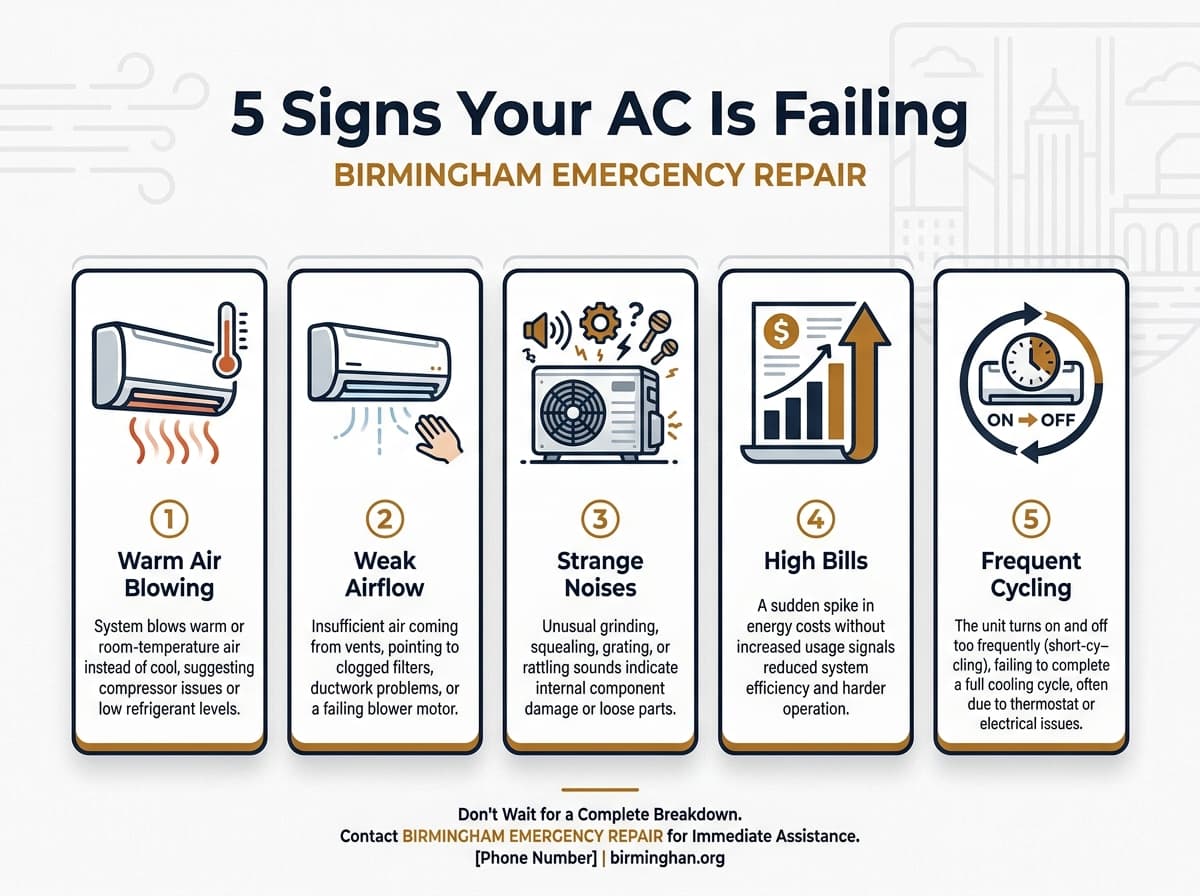
The 5 signs your Birmingham AC is about to fail: climbing energy bills, uneven cooling between rooms, strange new noises, short cycling (turning on and off every few minutes), and moisture or ice where it should not be. Act on any of these before the first summer heat wave hits.
The good news is that air conditioning systems almost never fail without warning. There are clear, recognizable signs that trouble is coming, and catching them early gives you the opportunity to schedule a repair on your terms rather than dealing with a full emergency breakdown at the worst possible moment. Here are five warning signs that Birmingham homeowners should watch for as summer approaches.
Sign 1: Your Energy Bills Are Climbing Without Explanation
If your Alabama Power bill during May and June is noticeably higher than it was at the same time last year despite no changes to your thermostat settings, your household size, or your daily routine, your AC system is likely losing efficiency. All air conditioning systems gradually lose efficiency as components age, but in Birmingham the decline happens faster because systems run longer and harder than in milder climates.
A system that was installed at 14 SEER ten years ago may be operating at an effective 10 or 11 SEER today. That efficiency loss translates directly to higher electricity consumption for the same amount of cooling. The compressor has to run longer cycles, the fan motors draw more current as bearings wear, and dirty coils reduce heat transfer, all of which show up on your power bill before they show up as a noticeable change in comfort.
| System Age | Original SEER | Estimated Current SEER | Efficiency Loss |
|---|---|---|---|
| 5 years | 14 SEER | 13 SEER | ~7% |
| 10 years | 14 SEER | 10-11 SEER | ~21-28% |
| 15 years | 10 SEER | 7-8 SEER | ~20-30% |
| 20 years | 10 SEER | 6-7 SEER | ~30-40% |
Pull out your electricity bills from the past three summers and compare the June through August totals. If you see a consistent upward trend of 15 to 20 percent or more that is not explained by rate increases, your system is telling you that major components are degrading. This does not mean failure is imminent, but it does mean your system is working harder than it should and the extra strain is accelerating wear on every component.
Birmingham homeowners in neighborhoods like Homewood, Crestwood, and Forest Park with homes built in the 1960s through 1980s are particularly susceptible to this pattern because their systems are often working against poor duct insulation in superheated attic spaces, which compounds the efficiency loss from aging equipment.
Key Takeaway
Compare your June-August electricity bills year over year. A consistent 15-20% increase without explanation is one of the earliest warning signs of AC system degradation.
Sign 2: Uneven Cooling Throughout Your Home
When certain rooms in your Birmingham home are comfortable while others feel noticeably warmer, your AC system may be struggling to maintain adequate airflow or cooling capacity. Some temperature variation between rooms is normal, especially in multi-story homes where upper floors naturally run warmer. But if the variation is new or has gotten significantly worse over the past season, it points to a developing problem.
The most common cause is a failing blower motor that can no longer push air through the ductwork with sufficient force. As blower motors age, their bearings wear and the motor gradually loses RPM. The rooms closest to the air handler stay comfortable because they receive air first, while rooms at the end of duct runs starve for airflow. You might notice that bedrooms furthest from the air handler are five to ten degrees warmer than the living areas near the thermostat.
Another cause is a low refrigerant charge from a slow leak. When refrigerant levels drop, the evaporator coil cannot absorb as much heat from the air passing over it. The system still moves air through the house, but that air is not being cooled as effectively. The result is lukewarm air from vents rather than cold, and the system runs constantly without bringing the house to the set temperature.
In Birmingham homes located in areas like Mountain Brook, Vestavia Hills, and over-the-mountain neighborhoods where many houses sit on sloped lots with complex duct routing, uneven cooling can also indicate ductwork separation or deterioration in the crawl space beneath the home. Alabama's humidity and occasional flooding make crawl space ductwork particularly vulnerable to damage.
AC acting up? Do not wait until it dies completely.
Call (205) 206-5252Sign 3: Strange Noises You Have Not Heard Before
A healthy AC system produces a consistent, relatively quiet hum when it is running. You should be able to hear it operating, but it should not command your attention. When new sounds appear, grinding, squealing, banging, clicking, or buzzing, your system is telling you that a mechanical or electrical component is in distress.
Grinding sounds from the outdoor unit typically indicate failing compressor bearings or a fan blade that is making contact with the housing. Either condition will worsen rapidly in Birmingham's summer heat because the thermal expansion from extreme outdoor temperatures amplifies the mechanical interference. A grinding compressor that might survive another month in April will often seize within days once temperatures hit the 90s.
Squealing from the indoor air handler usually points to a failing blower motor or a worn blower wheel. The sound may come and go at first, appearing during startup and fading as the system reaches operating temperature. As the condition worsens, the squealing becomes constant and the motor may begin to overheat, triggering thermal protection shutoffs that cause the system to stop and restart repeatedly.
Banging or clanking from the outdoor unit is serious. It often indicates a loose or broken component inside the compressor itself, such as a connecting rod, piston pin, or crankshaft. Once internal compressor components loosen, failure is typically weeks or even days away. The sooner you get a technician to evaluate the noise, the better chance you have of catching the problem before the compressor fails entirely, which is the most expensive common AC repair.
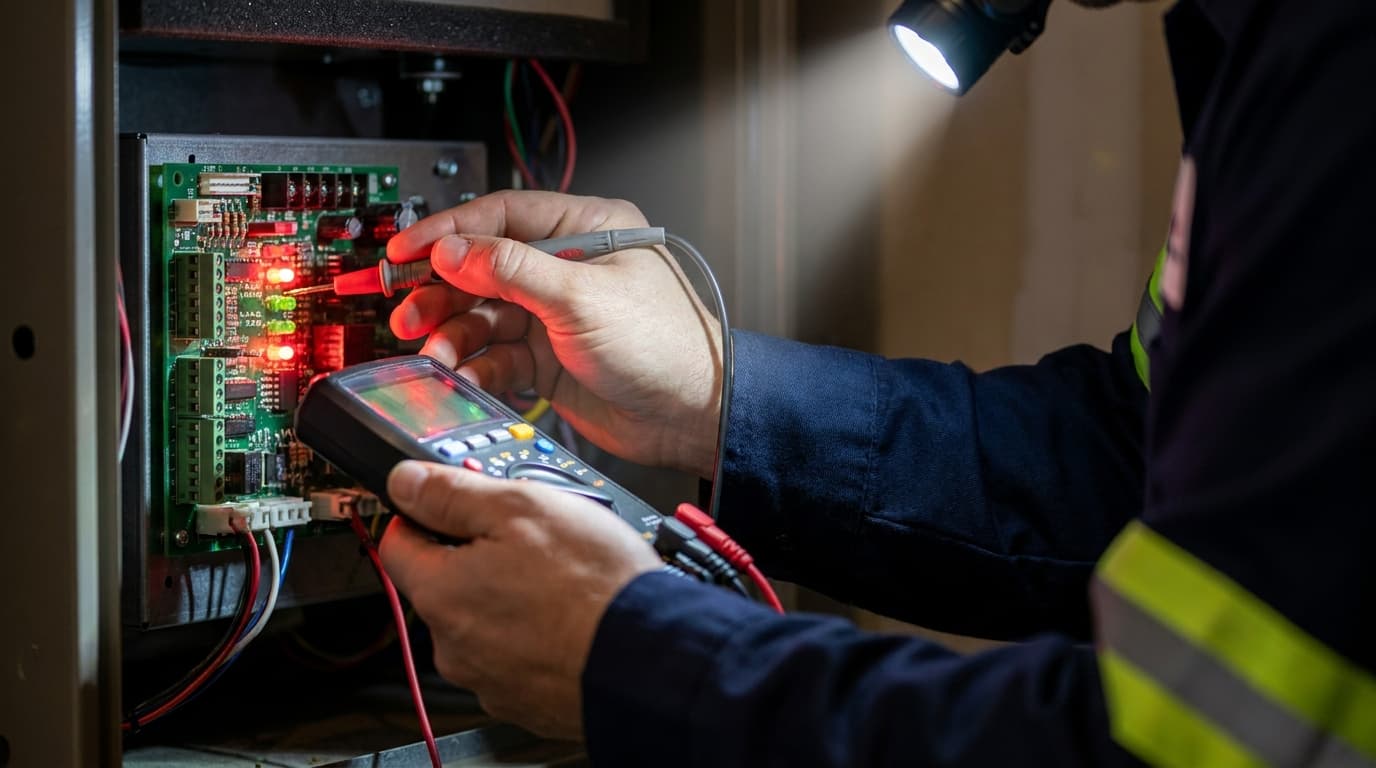
Buzzing from the outdoor unit when the system is trying to start but failing to fully engage usually points to a failing capacitor or contactor. These are relatively inexpensive repairs when caught early, but ignoring the buzzing can lead to compressor damage as the motor struggles to start against inadequate electrical support. In Birmingham, capacitors are among the most common failures we see because extreme heat degrades them faster than in cooler climates.
90+
degrees is when most capacitor failures occur — Birmingham summers push these components past their thermal limits
Sign 4: Your System Is Short Cycling
Short cycling means your AC turns on, runs for just a few minutes, shuts off, and then restarts shortly after. A healthy system in Birmingham should run in cycles of 15 to 20 minutes during moderate weather and may run nearly continuously during the hottest part of a July afternoon. If your system is cycling on and off every five minutes or less, something is wrong.
Short cycling is destructive because the startup phase places the most stress on the compressor. Each time the compressor engages, it draws a massive surge of electrical current that generates heat and mechanical stress. A system that short cycles 15 to 20 times per hour instead of the normal three to four times is experiencing roughly five times the normal startup wear. Over the course of a Birmingham summer, that accumulated stress can destroy a compressor that otherwise had years of life remaining.
The causes of short cycling include:
- A failing compressor overheating and tripping thermal protection
- A refrigerant leak causing the evaporator coil to freeze and trigger a pressure safety switch
- An electrical issue with the capacitor or contactor
- A dirty evaporator coil restricting airflow and causing internal overheating
If you notice your system short cycling, turn it off for 30 minutes to allow any thermal protection to reset, then turn it back on and observe. If the short cycling resumes immediately, do not continue running the system. Each cycle is causing further damage. Call for professional diagnosis before the underlying problem cascades into a compressor failure.
Key Takeaway
Short cycling does not fix itself — it gets worse. Every on-off cycle is damaging the compressor. If your system is cycling every 5 minutes or less, turn it off and call for professional diagnosis immediately.
Sign 5: Moisture or Ice Where It Should Not Be
Water stains on the ceiling below an attic-mounted air handler, puddles around the indoor unit, ice on the refrigerant lines running to the outdoor unit, or frost on the evaporator coil are all signs of a system in distress. Each of these moisture problems points to a different underlying issue, and all of them will worsen if ignored.
Water leaking from the indoor unit is most commonly caused by a clogged condensate drain line. In Birmingham, where your AC removes gallons of water from the air daily during summer, the drain line is prone to clogging from algae and mold growth that thrives in the warm, wet environment inside the pipe. A clogged drain causes the condensate pan to overflow, which can damage ceilings, walls, and flooring if the air handler is in the attic. Many systems have a safety float switch that shuts down the unit when the pan overflows, which prevents water damage but leaves you without cooling.
| Moisture Problem | Likely Cause | Risk If Ignored |
|---|---|---|
| Water around indoor unit | Clogged condensate drain | Ceiling damage, mold growth, system shutdown |
| Ice on refrigerant lines | Refrigerant leak or restricted airflow | Compressor damage, complete system failure |
| Frost on evaporator coil | Dirty filter or low refrigerant | Compressor liquid slugging, expensive repair |
| Water stains on ceiling | Overflowing drain pan in attic unit | Structural damage, mold remediation costs |
Ice on the refrigerant lines or evaporator coil indicates either a refrigerant leak or severely restricted airflow. When refrigerant levels drop due to a leak, the remaining refrigerant expands too much in the evaporator coil, causing the coil temperature to drop below freezing. Moisture from the air then freezes on the coil surface, further restricting airflow in a worsening cycle that eventually blocks the coil entirely. The system continues running but produces no cooling because the coil is encased in ice.
In all of these cases, the moisture or ice is a symptom, not the root cause. Wiping up the water or waiting for the ice to melt does not fix the underlying problem. A professional diagnosis identifies whether the issue is a simple drain clog, a filter problem, a refrigerant leak, or a more serious mechanical failure.
AC acting up? Do not wait until it dies completely.
Call (205) 206-5252What Birmingham Homeowners Should Do Now
If you recognize any of these signs in your AC system, the most important thing you can do is act before the first sustained heat wave of summer. Scheduling a professional evaluation in April or May, when HVAC companies have open availability and the weather is still manageable without AC, gives you the best outcome regardless of what the technician finds.
If the evaluation reveals minor issues like a worn capacitor, a dirty coil, or a slow drain line, a technician can address them in a single visit during a scheduled appointment. If the evaluation reveals a major problem that points toward system replacement, you have time to research options, compare estimates from multiple companies, and schedule the installation at a time that works for you rather than in the middle of a crisis.
At Emergency AC Repair Service, we provide honest, straightforward evaluations with no pressure and no gimmicks. Our technicians will tell you exactly what they find, explain your options clearly, and give you the information you need to make the right decision for your family. We serve the entire Birmingham metro area including Hoover, Vestavia Hills, Homewood, Mountain Brook, Trussville, Pelham, Alabaster, and Gardendale.
Call (205) 206-5252 to schedule an evaluation before summer arrives. The best time to find out your AC needs attention is before you desperately need it to work.
Frequently Asked Questions
What are signs my AC is about to fail this summer in Birmingham?
The five critical warning signs that your Birmingham AC is about to fail include unexplained increases in energy bills, uneven cooling between rooms, new or unusual noises from the indoor or outdoor unit, short cycling where the system turns on and off every few minutes, and moisture or ice appearing where it should not be. Catching these signs early allows you to schedule a repair before a full breakdown during peak summer heat.
Why do AC systems fail more often in Birmingham Alabama summers?
Birmingham summers force AC systems to run at or near maximum capacity for five to six continuous months, with temperatures regularly in the mid-90s and humidity averaging 70 to 85 percent. This extended, high-demand runtime accelerates wear on compressors, capacitors, contactors, and fan motors far faster than in milder climates. Systems that might last 15 to 20 years elsewhere typically last 10 to 15 years in Birmingham.
How can I prevent my AC from failing this Birmingham summer?
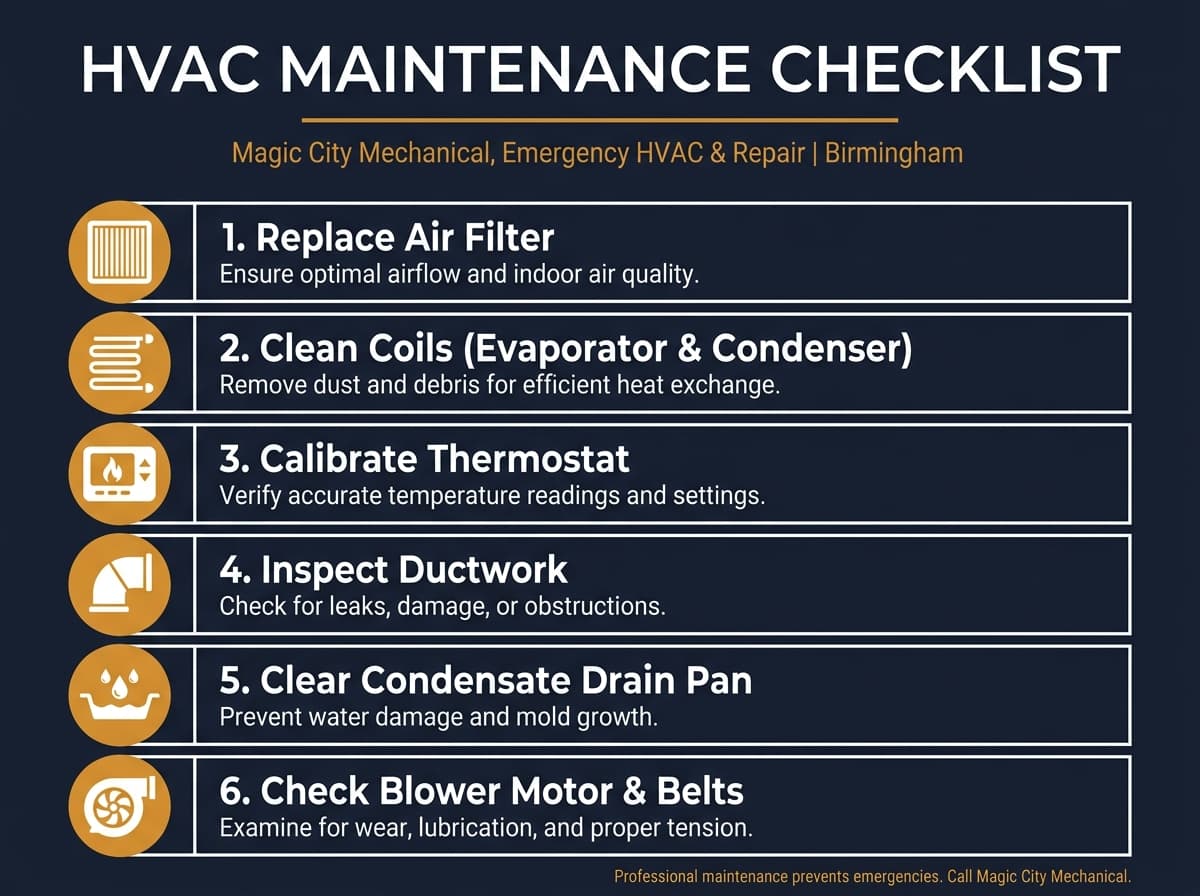
Emergency AC Repair Service recommends scheduling a professional spring tune-up in March or April before the summer heat arrives. During this visit, the technician tests all electrical components, measures refrigerant levels, cleans coils, and checks the condensate drain. Between professional visits, change your air filter monthly from April through October and keep the outdoor unit clear of debris.
What does AC short cycling mean and is it dangerous?
Short cycling means your AC turns on, runs for just a few minutes, shuts off, and restarts shortly after. This is destructive because the startup phase places the most stress on the compressor. A system that short cycles 15 to 20 times per hour instead of the normal three to four times experiences roughly five times the normal startup wear, which can destroy a compressor that otherwise had years of life remaining. If your system is short cycling, turn it off and call for professional diagnosis.
Should I schedule AC maintenance before summer in Birmingham?
Absolutely. A spring tune-up before Birmingham summer is the most effective way to prevent emergency AC failures. HVAC companies have open availability in April and May, and the weather is still manageable without AC. A maintenance visit catches worn capacitors, low refrigerant, dirty coils, and clogged drain lines before they cause a breakdown during the worst possible time. Call Emergency AC Repair Service at (205) 206-5252 to schedule.
Free Birmingham HVAC Homeowner Checklist
Download our seasonal maintenance checklist designed for Birmingham's climate. Covers spring prep, summer survival, fall tune-up, and winter protection — the same checklist our technicians use on service calls.
Call (205) 206-5252 to RequestSources & Citations
- U.S. Environmental Protection Agency — Indoor Air Quality
- U.S. Department of Energy — Heating & Cooling
- ASHRAE — American Society of Heating, Refrigerating and Air-Conditioning Engineers
- ENERGY STAR — Heating & Cooling Equipment
- Alabama General Contractor Licensing Board
- U.S. EPA — Section 608 Technician Certification
Emergency AC Repair Service Editorial Team
Licensed HVAC Professionals • Birmingham, Alabama
Our content is written and reviewed by an Alabama-licensed, EPA Section 608–certified editorial team focused on residential AC and cooling systems. This piece was reviewed against the preventive-maintenance routine our technicians run before each cooling season — coil cleaning, electrical checks, and the wear patterns that decide whether a unit makes it through an Alabama August.
Related Resources
Need Emergency AC Repair in Birmingham?
Available 24/7 across the Birmingham metro area. Licensed and insured.
(205) 206-5252Read Next