BTU Calculator. For one room.
Right-size the cooling for any single room in your Leeds, Moody, Pinson, Clay, or Springville home. The math is the ACCA Manual J residential rule of thumb, tuned for Birmingham's humid Cfa climate. Free, no email, no upsell.
Where the number comes from.
Every legitimate residential cooling-load formula starts the same way: square footage times a base BTU/sq ft factor for the climate, then adjusted for ceiling height, insulation, sun orientation, and occupant heat.
The base rate
We use 25 BTU per square foot because the east corridor sits in the humid subtropical Cfa climate zone. Dry-climate calculators (Denver, Phoenix) use 18-20. Wet-climate calculators (Houston, Miami) use 28-32. Twenty-five is the right anchor for Alabama.
Ceiling adjustment
The 25 BTU/sq ft baseline assumes an 8-foot ceiling. A 10-foot ceiling means 25% more air volume to cool. The calculator multiplies by (ceiling / 8) automatically — vaulted Leeds homes are routinely undersized because the previous installer skipped this step.
Insulation modifier
A 1965 Pinson brick ranch with original single-pane windows and R-11 attic insulation needs 15% more cooling than a 2018 Moody build with R-49 attic and double-pane low-E glass. The modifier handles the gap.
Sun exposure
A west-facing master bedroom over a Springville driveway gets baked from 2 PM to sundown in July. We add 15% over baseline. North-facing rooms with mature tree cover get 10% off. Sunrooms and glass-walled additions are special cases — call us.
Occupant adder
Every adult occupant beyond the first two adds about 600 BTU/hr of sensible and latent heat. A bedroom occupied by two is the base case; a home office with three people and three monitors is a different problem.
Source standards
The full residential cooling-load standard is ACCA Manual J 8th Edition and ASHRAE Handbook — HVAC Applications. Every Emergency AC Repair Service install begins with a measured Manual J using residential load-calculation software, not this rule of thumb. The U.S. Department of Energy also documents the importance of right-sizing in the Energy.gov central AC guide.
Five-step process.
Measure the room
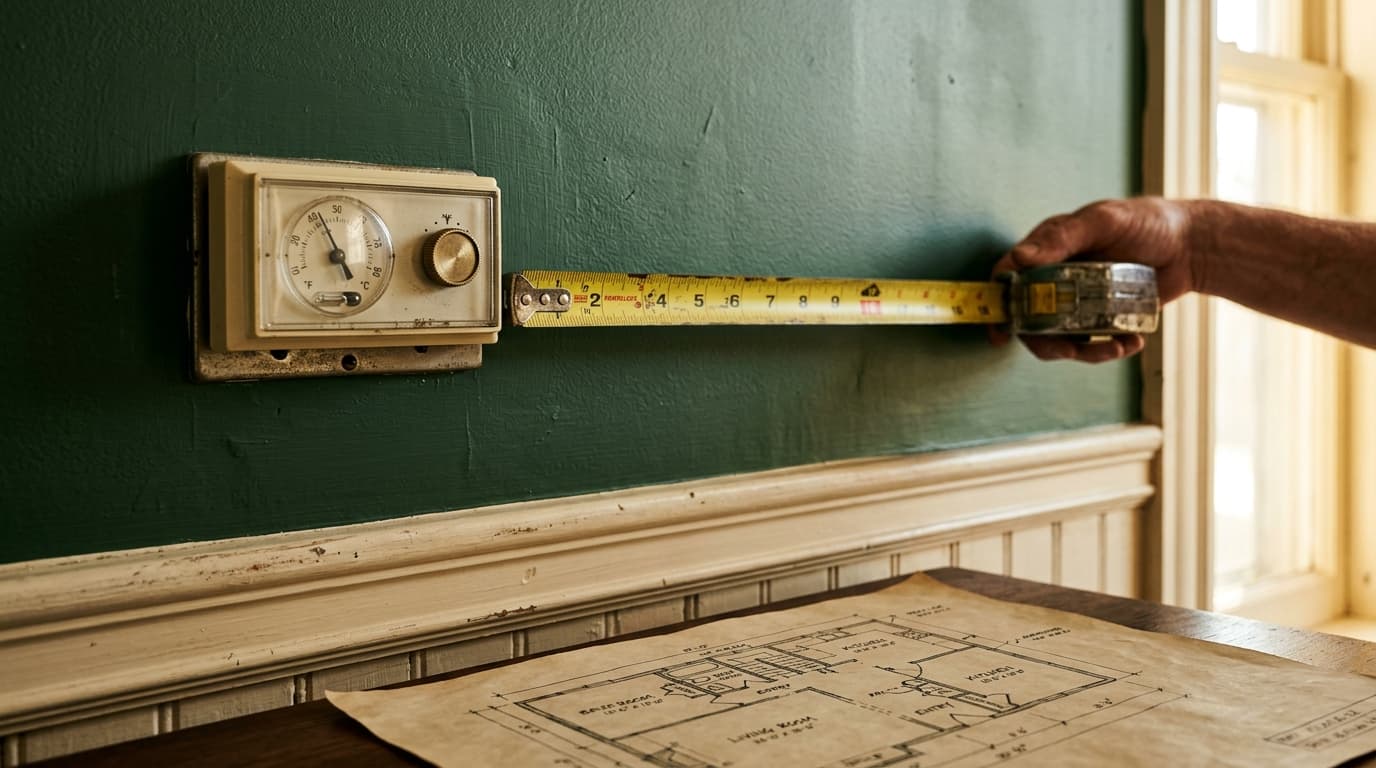
Pull a tape measure across length and width. Round to the nearest foot. L-shaped rooms: treat each rectangle separately and add the BTU numbers together.
Note the ceiling height
Most homes are 8 ft. Vaulted or older east-corridor homes with 9-12 ft ceilings need the proportional adjustment — the calculator handles it.
Assess insulation honestly
If road noise is audible on a calm day, your insulation is below average. If your power bill spikes hard in July, sun exposure or duct leak is the issue, not the BTU number alone.
Count typical occupants
The base formula assumes 2 occupants. Each additional regular occupant adds 600 BTU/hr — body heat is real cooling load in a tight room.
Compare to existing equipment
If the calculator says 24,000 BTU and your unit is a 2-ton (24,000 BTU), you are sized right. If your unit is 18,000 and the tool says 30,000, the equipment is the bottleneck — not the thermostat.
Three services that fix sizing problems.
AC Installation
Every new system gets a measured Manual J. Right-size the equipment, pull the permit, verify startup.
Ductless Mini-Split
Our east-corridor specialty. The BTU number from this tool maps directly to a single- or multi-zone Mitsubishi, Fujitsu, or Daikin head.
Duct Cleaning & Sealing
Right-sized AC paired with leaky ductwork loses 20-30% of capacity into the crawl space. Test, seal, recover the BTU.
BTU questions, answered straight.
How accurate is this BTU calculator?+
This tool uses the ACCA Manual J residential rule of thumb — about 25 BTU per square foot for Alabama's humid Köppen Cfa climate — adjusted for ceiling height, insulation, sun exposure, and occupants. It will get you within 10-15% of a measured Manual J for a typical east-corridor home. For an actual install, we run a full Manual J on paper before quoting equipment.
How many BTU does a Birmingham room need per square foot?+
Twenty-five BTU per square foot is the residential baseline for Birmingham at an 8-foot ceiling. A 200 sq ft bedroom needs about 5,000 BTU/hr; a 14×16 living room needs about 5,600 BTU/hr; a 600 sq ft Pinson master suite with afternoon western sun needs about 17,000 BTU/hr. Dry-climate calculators (Denver, Phoenix) use 18-20; Gulf Coast (Houston, Miami) uses 28-32.
Why does oversized AC cool worse than right-sized AC?+
Oversized AC short-cycles — it cools the thermostat fast, shuts off, and never runs long enough to pull humidity out of the air. The result is a cold, clammy house and an early compressor failure. East-corridor summers run 95°F+ with 70°F+ dewpoint — sizing right matters more here than in dry climates.
Does this work for a whole house or just one room?+
This calculator is for a single room or zone. For whole-house cooling, add up the BTU/hr for every conditioned room, then subtract about 10% for shared interior walls. Or call us — a whole-house Manual J is part of every new install quote.
What about ductless mini-splits — same math?+
Same load calculation. The difference is the equipment class. A 12,000 BTU calculator result fits a 1-ton single-zone mini-split head perfectly. A 24,000 BTU result for a two-bedroom area pairs cleanly with a two-zone Mitsubishi or Fujitsu system. We install ductless as our specialty across the east corridor.
How much should I add for sun exposure?+
West and south-facing rooms with no shade get baked all afternoon — we add 15% over baseline. North-facing or heavily shaded rooms get a 10% reduction. Sunrooms and skylights are special cases that need a real load calc — the rule of thumb under-counts them every time.
What ceiling height does the formula assume?+
The base 25 BTU/sq ft assumes an 8-foot ceiling. The calculator adjusts proportionally — a 10-foot vaulted ceiling needs 25% more cooling for the same floor area. Older east-corridor homes with original 9-10 ft ceilings are routinely undersized for exactly this reason.
Need a real Manual J?
We measure the house room by room, check duct static, and put the right-size equipment number on paper before any quote.
Call (205) 206-5252